

ground improvement
Soil Stabilization Methods: Lime, Cement and Mechanical
The main soil stabilization methods, how lime and cement change a subgrade, the dosage and mix design tests behind them, and a worked example you can check.

A subgrade that turns to grease after rain, or a clay that swells under the slab while shrinking away from it in summer, puts a project in front of the same decision: haul the material out and import fill, or treat the soil where it lies and build on top of it.
Soil stabilization is the second route. It is a design exercise with a laboratory behind it, not a product a contractor spreads until the ground looks better. Get the dosage right and you end up with a working platform, a subgrade, or a base layer that carries load. Get it wrong and you find out months later, when the treated layer heaves or cracks and the pavement above it fails.
This guide covers the methods in current use, the soil properties that decide between them, the tests that produce a mix design, and a worked dosage calculation with the arithmetic laid out.
What stabilization actually changes
Two different objectives sit under the same word, and confusing them is the most common source of a bad specification.
Modification changes the index properties of the soil. The plasticity index drops, the material becomes easier to compact, and it stops moving with moisture. A modified subgrade is a better host for the layers above it; it is not a structural layer in its own right.
Stabilization raises strength and stiffness, so the treated soil becomes part of the pavement structure or carries foundation loads directly. It requires a minimum unconfined compressive strength that the laboratory mix design has to demonstrate.
A specification that asks for “lime stabilized subgrade” without saying which of the two is wanted cannot be checked in the field. The acceptance test is different in each case: plasticity index after mellowing for modification, unconfined compressive strength for stabilization.
The soil properties that decide the method
Five tests on the subgrade tell you which methods are viable before anyone prices anything.
- Gradation and classification. Sieve and hydrometer analysis with classification to ASTM D2487 separates a clean sand, where cement and mechanical blending work well, from a fat clay, where lime is the natural first candidate.
- Plasticity. Atterberg limits to ASTM D4318 give the liquid limit, plastic limit and plasticity index. Clayey soils with a plasticity index of roughly 10 or more are the ones lime can modify; low plasticity silty sands point to cement instead.
- Natural moisture content to ASTM D2216. Wet soil compacts badly, and the dosage that dried it in one part of the site may be too low or too high in another.
- Soluble sulfate content to ASTM C1580, with the colorimetric sulfate test used by the Texas Department of Transportation (Tex-145-E) as the quick routine check. This one test disqualifies certain soils from calcium-based stabilization, for reasons covered below.
- Organic content to ASTM D2974. Organic matter consumes the binder and interferes with the pozzolanic reaction, so highly organic soils need a different approach rather than a bigger dose.
Skip any of these and you are designing blind. A single set of samples per soil type is enough to start; the samples should be sealed, labelled by chainage, and kept for the trial mixes so that the material tested in the laboratory is the material the contractor will spread lime into.
The stabilization methods compared
| Method | How it works | Soils where it fits | Typical dosage | Where it stops working |
|---|---|---|---|---|
| Mechanical blending | Proportion two or more materials to reach a target gradation, then compact | Soils with a missing fraction that a local borrow material supplies | Set by the blend, not a percentage | Poorly graded fine soils with no usable borrow nearby |
| Geosynthetics | A geogrid or geotextile separates, reinforces or drains | Soft subgrade under a granular platform or embankment | 1 to 3 layers of grid | Deep weak layers; it does not change the soil itself |
| Lime | Cation exchange and pozzolanic reaction with clay minerals | Clays and silty clays with a plasticity index above about 10 | 3 to 6 percent of dry soil mass | Sands with no clay fraction, soils with high sulfates or organics |
| Cement | Hydration binds the particles; strength gain is fast | Sands, silty sands, low plasticity soils, and clays at higher dose | 5 to 12 percent of dry soil mass | Organic, sulfate-bearing and very plastic soils; mixing window is short |
| Lime plus fly ash or slag | Slower pozzolanic reaction with a by-product binder | Sulfate-bearing and wet soils where straight lime or cement is risky | 4 to 8 percent combined | Slow strength gain can miss a tight programme |
The table is a shortlist, not a decision. The rest of this article works through the two methods that account for most projects, then shows where the decision actually goes.
Lime stabilization
Lime does two things, on two very different clocks.
The first is immediate. Calcium ions from the lime displace the cations held on the surface of the clay particles. The particles flocculate into larger, coarser aggregates, and the soil turns from a plastic clay into a crumbly, workable material. This is the reaction that lets a contractor open up a wet subgrade in a day. It shows up as a drop in plasticity index and a rise in the optimum moisture content, measured on compacted samples.
The second is slow. The strong alkali attacks the silica and alumina at the edges of the clay particles, and the reaction products cement the particles together. This pozzolanic reaction is why a lime-treated layer keeps gaining strength for months, and why a seven-day strength is a conservative estimate of what the layer will have in service.
Which lime you buy matters for quantities. Quicklime (calcium oxide) is the product most state specifications are written around, because it reacts hardest and dries the soil as it hydrates. Hydrated lime (calcium hydroxide) is quicklime that has already been slaked at the plant, so it is safer to handle and slower to react. The two deliver the same calcium at different masses: the molecular weights give a ratio of 74 to 56, so replacing quicklime with hydrated lime at the same calcium dose increases the mass by about 32 percent. Both products are specified under ASTM C977 or AASHTO M 216.
The dose is not guessed. The pH method in ASTM D6276 mixes a series of lime percentages with the soil and measures the pH of each mixture. The pH sits low and rises sharply once there is enough lime to satisfy the soil’s exchange capacity; the point where it settles above about 12.4 is the lime fixation point, and the design dose starts there and moves up until the strength or plasticity criterion is met. That single test explains why two clays that look alike need doses of 3 and 6 percent.
Lime suits clays; it struggles elsewhere. The industry guidance is compact: a fine-grained soil is a good candidate when at least 25 percent passes the 75 µm (No. 200) sieve and the plasticity index is 10 or higher, because the pozzolanic reaction needs clay minerals to feed on (Lime-Treated Soil Construction Manual). A clean sand with no fines has nothing for lime to react with, so it is not a lime soil in any useful sense, however dry the lime makes it look in the first week.
Three failure modes are worth naming before they happen.
Sulfate heave. In soils with soluble sulfates, calcium from lime or cement reacts with the sulfates and the clay to form ettringite and thaumasite, which grow in the presence of water and lift the treated layer. It can appear months after paving. The screening test is the soluble sulfate content, and the thresholds follow the recommended practice in NCHRP Web-Only Document 145: below about 3,000 ppm (0.3 percent) calcium-based stabilization follows standard practice; at or above that level the mix design has to deal with sulfates specifically; and from roughly 5,000 to 8,000 ppm the calcium-based route stops being a good idea, so the answer is a sulfate-resistant system such as ground granulated blast furnace slag with lime, or a Class F fly ash blend. The general counterpart is Recommended Practice for Stabilization of Subgrade Soils and Base Materials (NCHRP Web-Only Document 144), and the sulfate-specific one is Recommended Practice for Stabilization of Sulfate-Rich Subgrade Soils (NCHRP Web-Only Document 145). The same scale is reproduced in the Caltrans guidelines for stabilization of subgrade soils.
Organic soil. Above about 1 to 2 percent organic content the reaction is starved and the treated layer never reaches the design strength, and the Caltrans guidelines put the practical ceiling for an economical dose lower still. Treat it as a different problem: removal, a geosynthetic-supported platform, or a binder system tested specifically for that soil. The limit comes from the National Lime Association’s technical brief on mixture design and testing, and the test that measures it is ASTM D2974.
Lime as a drying agent. Adding lime to dry a wet subgrade, compacting it, and calling the result stabilized leaves a soil with changed texture and almost no strength gain. If the design intends real stabilization, the test results have to show it.
Cement stabilization
Portland cement reacts with water and binds the soil particles, and it does so fast. The practical consequences follow from that speed: strength appears within days rather than months, but the window between mixing and compaction is short, and once the cement has begun to set, a layer that has not been compacted is spoiled.
Cement suits what lime does not. Sandy and low plasticity soils bind well, and soil-cement is the classic solution for erosion protection on slopes and channels. In clays it works at higher doses, and the result can be strong but brittle, with shrinkage cracking that needs to be judged against the load the layer has to carry.
Doses run from about 5 to 12 percent of dry soil mass, chosen the same way as for lime: trial mixes at a range of percentages, cured, then tested for unconfined compressive strength. The test methods differ by binder, which matters when writing a specification: soil-lime mixtures are tested under ASTM D5102 and soil-cement under ASTM D1633, and a laboratory that runs the wrong one will report numbers that are not comparable. ASTM D4609 is the screening guide used to compare how effective different admixtures are in a given soil before committing to full mix designs; it was withdrawn in 2017 but agencies still cite it.
The same sulfate problem applies, with the same thresholds. And because cement is a manufactured product with a large thermal load, blends are now common: cement with slag, or lime with a Class F fly ash, trade slower strength gain for lower heat, less shrinkage and better sulfate resistance.
Blends and by-product binders
Where a soil fails the sulfate screen, or where enough binder is needed that straight cement becomes the dominant cost, the answer is usually a blend.
Ground granulated blast furnace slag is the sulfate-resistant option of choice. It reacts slowly, so it needs a mix design with a longer cure and a realistic construction programme, but it does not feed the ettringite reaction the way calcium alone does. Class F fly ash blended with a small percentage of lime behaves similarly. Lime kiln dust sits in between cement and lime: it brings some cementitious reactivity, suits moderately plastic clays, and is often used where a pure lime dose would be large.
The engineering is the same in every case. The blend is a binder system with its own optimum dose for that soil, and it earns its place by passing the same strength and durability tests as lime or cement.
Geosynthetics, and when they beat chemistry
A geogrid or geotextile does not change the soil, and it is worth being clear about that before comparing it with a binder. What it changes is how load spreads through a platform built on top of the soil.
In a working platform over soft ground, a layer of granular fill with one or more geogrid layers develops tension and forces the failure surface deeper, so the platform carries plant that the bare subgrade could not. The mechanism and its limits are set out in the FHWA geotechnical manual for pavements and in the FHWA ground improvement manual. One nuance matters when the two options are compared on a paved layer: what FHWA credits to a geosynthetic inside a pavement structure is mainly separation and protection of the base from the subgrade, not a structural gain of the kind a binder produces. Where it stops is depth: reinforcement makes the granular layer work, it does not fix a weak layer 4 m down, and the subgrade still settles under the platform.
For a subgrade or a base that has to be built to a stiffness and work in all weather, chemistry wins; for a temporary platform over soft ground, reinforcement usually does. Sorting that out early saves a specification that tries to do both jobs.
How to choose
Work through the decision in this order. Each step removes options, and the answer is usually obvious by the fourth question.
- How deep is the weak material? Treatment is a shallow solution, generally the top 300 to 500 mm (12 to 20 in) that a stabilizer can reach in one pass, and the largest reclaimers are rated at about 500 mm (20 in). A weak layer deeper than that, or a requirement to control settlement of a structure, is a different problem.
- Is the soil reactive? Clays with a plasticity index above about 10 point to lime. Sandy, silty, low plasticity soils point to cement.
- Do the sulfates or organics rule calcium out? Above the screening limits, go to a slag or Class F fly ash blend, or change the approach entirely.
- What is the layer for? Modification for construction access only needs the plasticity criterion. A structural layer needs a strength criterion from the pavement design, and both need the same laboratory work.
- Is it a permanent layer or a working platform? Permanent layers justify the mix design, the trial and the field testing. A platform for a season may be better served by reinforcement and granular fill.
The figure below maps the same logic onto the three soil types that turn up most often, with the two screening tests that override everything else.
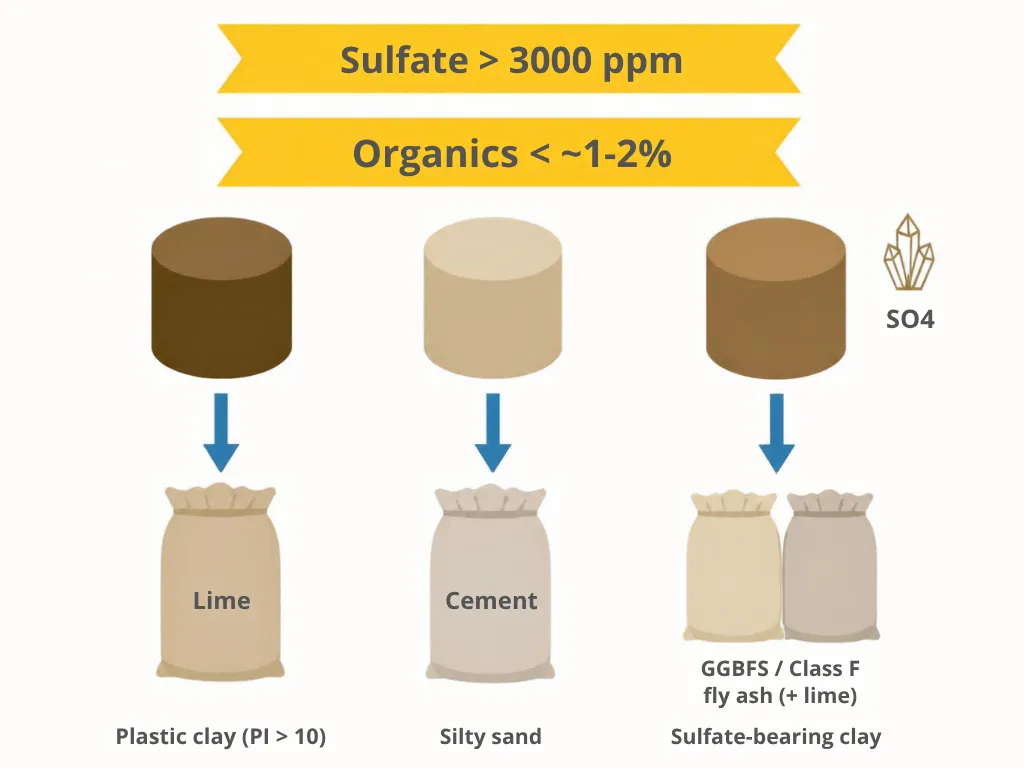
Two checks sit on top of the sequence. The first is the project programme: cement reaches its strength in days, lime in weeks, slag blends in months, and the layer cannot be trafficked or paved over before it is cured. The second is verification: every method here depends on a quality of mixing that only a trial area and field tests can confirm.
Mix design: the laboratory sequence
A mix design is the document that turns a soil and a binder into a dosage, a density and a moisture content. The sequence is the same for lime, cement and blends.
- Sample and classify. Bulk samples per soil type, sealed, from the actual alignment. Classification to ASTM D2487 with gradation, plasticity, natural moisture and specific gravity to ASTM D854.
- Run the disqualifying tests. Soluble sulfates to ASTM C1580 and organics to ASTM D2974, on every material.
- Find the demand. For lime, the pH method of ASTM D6276 gives the fixation point. For cement and blends the binder demand is established by trial, or screened first with a guide such as ASTM D4609.
- Compact the treated samples. Max dry density and optimum moisture content of the treated mix, not the natural soil, using standard Proctor (ASTM D698) or modified Proctor (ASTM D1557) as the specification requires. The two give different densities, so the specification and the laboratory have to agree on one.
- Mould, cure and test. Specimens at each dosage, then unconfined compressive strength: ASTM D5102 for soil-lime, ASTM D1633 for soil-cement. The two cure differently and the results are not interchangeable. D5102 wraps and seals the specimens for 7 days at 40 °C and then soaks them by capillary rise for 24 hours, an accelerated regime that is not the same as 7 days in the field. D1633 cures them in a moist room. A strength number means nothing without the method and the curing that produced it.
- Record the result. The report should state the lowest dosage that meets the criterion plus the treated density and moisture content at that dosage. Those two numbers are what the field acceptance testing is compared against.
- Check durability where the layer will be exposed to wetting and drying or freeze and thaw: ASTM D559 and ASTM D560 lose a measurable percentage of mass and strength, and the specification needs a limit.
The National Lime Association’s technical brief on mixture design and testing for lime stabilized soils and the Portland Cement Association’s soil-cement inspector’s manual set out the same sequence in more detail, and they are the usual references when a state specification is silent.
Worked example: dosage for a lime-stabilized subgrade
Take a 300 mm (12 in) subgrade layer of a plastic clay on a 1,000 m (3,281 ft) long access road, 7.3 m (24 ft) wide, and design the lime dose.
| Input | Value |
|---|---|
| Soil classification (ASTM D2487) | CL, clay fraction 32 percent |
| Liquid limit / plasticity index | 46 / 28 |
| Natural moisture content | 24 percent |
| Soluble sulfate (ASTM C1580) | 800 ppm |
| Organic content (ASTM D2974) | 1.1 percent |
| Binder | Quicklime, specified to ASTM C977 |
| Layer thickness | 300 mm (12 in) |
| Treated max dry density (standard Proctor) | 18.0 kN/m³ (114.6 pcf) |
| Treated optimum moisture content | 16 percent |
| Specified field compaction | 98 percent of max dry density |
| Acceptance criteria | Plasticity index ≤ 10 after mellowing, and 7-day UCS ≥ 690 kPa (100 psi) to ASTM D5102 |
Step 1: how much soil is in a square metre. The density the contractor has to achieve is 98 percent of the maximum dry density of the treated mix:
Dividing by gravity gives a mass density of about 1,800 kg/m³ (112 pcf). Over a 300 mm layer, the dry mass of soil per square metre is:
That is 110.6 lb/ft², or about 995 lb/yd² of soil to treat.
Step 2: the lime demand. The pH series of ASTM D6276 gives a fixation point at 4 percent: below that the pH stays under 12.4, above it the curve flattens. Trial mixes at 3, 4, 5 and 6 percent, compacted to the treated density and tested for strength, give:
| Lime dose (percent of dry soil mass) | PI after mellowing | 7-day UCS |
|---|---|---|
| 0 | 28 | 180 kPa (26 psi) |
| 3 | 12 | 420 kPa (61 psi) |
| 4 | 6 | 560 kPa (81 psi) |
| 5 | 5 | 700 kPa (102 psi) |
| 6 | 5 | 810 kPa (117 psi) |
The plasticity criterion is met at 4 percent. The strength criterion is not: 560 kPa is short of the 690 kPa the pavement design asks for. The lowest passing dose is 5 percent, and that is the design dosage. Note which number decided it: the absolute strength the pavement design asks for, not a typical strength gain quoted in vendor literature. A range of gains cannot set a dose, and a dose taken from the fixation point alone would have left the layer about 19 percent short of the target.
Step 3: lime per square metre. Five percent of 540 kg is:
which is 5.5 lb/ft², or 49.8 lb/yd² of quicklime.
Step 4: quantity for the whole road. The treated area is 1,000 m × 7.3 m = 7,300 m² (8,730 yd²). The quicklime total is:
or about 217 short tons.
Step 5: what happens if the site uses hydrated lime. The specification states the dose as a percentage of dry soil mass of quicklime, so switching products at the same calcium content means more mass. Converting to hydrated lime:
The 74/56 ratio comes from the molecular weights of calcium hydroxide and calcium oxide, and it is the same 0.757 factor that quantity clauses use when they pay for hydrated lime as a proportion of quicklime tonnage. A crew that keeps spreading 5 percent by mass of hydrated lime instead of quicklime is delivering about a quarter less calcium than the mix design assumed.
Step 6: water, and why quicklime dries the site. Quicklime hydrates in the soil, taking one molecule of water per molecule of calcium oxide. That is 18.0 kg of water for every 56.1 kg of quicklime, a factor of 0.321, so the tonnage above will chemically consume:
spread across the layer. That is the drying effect contractors see, and it is also why the mixing moisture for compaction has to be checked rather than assumed from the natural moisture content: the optimum moisture content of the treated mix, 16 percent here, is what the field has to reach, and it is partly consumed as the lime reacts.
Site work: the sequence that matters
The design numbers only reach the ground if the sequence is followed. On a lime-stabilized subgrade it runs:
- Shape and pulverize. Grade to the working level and rip or pulverize the soil. The usual specification is 100 percent of the non-stone material passing a 50 mm (2 in) sieve before the binder is spread, and after mixing 100 percent passing a 25 mm (1 in) sieve with at least 60 percent passing the 4.75 mm (No. 4) sieve (Lime-Treated Soil Construction Manual).
- Spread the binder at the rate from the mix design, mechanically, with the spread checked against the plan area rather than by eye.
- Mix in two passes, bringing the binder to the full depth of the layer. Under-mixing the bottom 50 mm is the most common reason a treated layer tests low.
- Add water to the treated optimum, then mellow the mix. Lime specifications typically call for 24 to 48 hours of mellowing, longer for highly plastic clays, so that the reaction runs before compaction.
- Remix, compact to the specified percentage of the treated maximum dry density, and finish to grade in the same shift.
- Cure, and keep traffic and water off it. For lime, days; for cement, hours count. Paving over a layer before it has cured locks in whatever strength it had.
- Test. Field density and moisture at a defined frequency along the length, and strength samples from the placed material. Proof rolling the finished surface is a cheap check on whether the layer is uniform.
Quicklime is a hazardous material. It burns skin and eyes on contact and reacts with moisture, and the dust needs control with the right protective equipment. That is a site management issue, not an argument against the method, but it has to be in the method statement.
Six ways a stabilized layer fails
- Sulfate heave, where the soil was never screened, appears months after the pavement is open. It is the most expensive failure on this list and the cheapest to prevent.
- Dose by eye. A layer at 3 percent where the mix design says 5 percent looks and feels similar on the day and fails the strength test.
- Insufficient mellowing. Compacting lime into clay too quickly leaves unreacted lumps that swell later, under the pavement.
- Compaction after the cement sets, which turns a designed layer into compacted rubble.
- No moisture control. Dry mixing leaves the binder unreacted; overwetting after a lime dose pushes the layer past its optimum and it compacts to a low density.
- Testing the wrong thing. Plasticity index for a structural layer, or a strength sample cured in the open air instead of sealed, produces numbers that do not describe the layer that was built.
Frequently asked questions
Is lime or cement better for soil stabilization? They suit different soils. Lime reacts with clay minerals, so it is the first choice for plastic clays with a plasticity index above about 10. Cement binds with less dependence on clay content, so it suits sandy and low plasticity soils and gives strength much faster. Where a soil sits in the middle, the answer comes from the trial mixes, not from the general rule.
How much lime do I need to stabilize soil? Between about 3 and 6 percent of the dry mass of the soil, occasionally more when the clay is highly plastic, and the number for a specific soil comes from two tests: the pH method of ASTM D6276 for the lime demand, and a strength or plasticity series for the design dose. On the subgrade in the worked example, 4 percent was enough to modify and 5 percent was needed to stabilize.
Can I stabilize soil with cement instead of lime? Yes, and for clean sands and low plasticity silts cement is usually the better performer. The constraints are the working window, which is short, and the same sulfate and organic content screening that applies to lime.
How long does a stabilized layer take to reach full strength? Cement reaches most of its design strength within days. Lime continues to gain strength for months, so a seven-day result is a conservative indicator. Slag and fly ash blends are slower still, and the construction programme has to allow for the curing period before the layer is trafficked or covered.
Can I use stabilized soil under a foundation? Only as a designed element with its own verification, and rarely as a substitute for founding at depth. A stabilized working platform or a treated raft bearing layer can be legitimate for lightly loaded structures where the mix design and field testing support it. When the requirement is settlement control under a structure, the ground improvement and foundation options are the more reliable route.
Does stabilization work for expansive clay? It is one of the main uses of lime. Cation exchange reduces the plasticity and the swell potential immediately, and the pozzolanic reaction adds strength over time. The soil still has to pass the sulfate screen, and the improvement has to be confirmed by swell testing on the treated mix rather than assumed.
Where to go next
Stabilization sits between the ground investigation and the structure, and it is easier to specify once the investigation is understood. How to read a geotechnical report walks through the sections that matter for a decision like this one, and the ground improvement techniques guide covers the deeper alternatives when treatment of the top 300 mm is not going to be enough.
If settlement is the problem rather than subgrade strength, start with foundation settlement to see how the limits are set, and with gross and net bearing pressure to make sure the pressures you are comparing against are the right ones. You can run the bearing capacity and settlement side of the question in the browser with the shallow foundation tools, and deep foundation tools are there when the numbers push the foundation past the treated layer.