How to Read a Geotechnical Report, Step by Step


A geotechnical report is a boring document unless you know what you are looking at. Most people who receive one are not soil engineers: they are structural engineers, developers, contractors, or owners who need one number out of it (the allowable bearing pressure, or whether the site needs piles) and have to trust the rest.
This guide is a map. It walks through what a geotechnical report contains, where each piece of information lives, and how the field and laboratory numbers feed the foundation recommendation. It ends with a worked example that reads a real borehole log, estimates bearing capacity from the corrected SPT blow count, and arrives at the number you would hand to the structural engineer.
You will not become a geotechnical engineer by reading this. You will be able to read a report without guessing, and you will know which results still belong to the geotechnical engineer to decide.
What a geotechnical report is and who writes it
A geotechnical report is a sealed engineering document prepared by a licensed geotechnical engineer (or firm) that summarizes the subsurface conditions at a specific site and translates them into design parameters and construction recommendations.
It is site-specific. A regional geology map tells you what is likely under your area; a geotechnical report tells you what was actually found under your lot, from borings, test pits, and laboratory tests done on your samples.
The report serves several readers at once:
| Who reads it | What they take from it |
|---|---|
| Structural engineer | Allowable bearing pressures, settlement estimates, foundation recommendation, seismic site class |
| Developer / owner | Feasibility, risk, and how site conditions affect cost |
| Contractor | Excavation support, dewatering, fill and compaction requirements |
| Building department | Documentation that the design accounts for the ground |
Because the readers differ, the report is structured into parts, and each part answers a different question.
The skeleton of a report
Most reports follow the same order. Once you know it, you can jump straight to the section you need without reading cover to cover.
- Introduction and scope — the project, the site, who authorized the work, and what the investigation was meant to answer.
- Site description — location, topography, drainage, neighboring structures, and any history of fill or grading.
- Field exploration — how many borings, to what depth, what sampling methods, and where they were located on a plan.
- Laboratory testing — which index and strength tests were run on the recovered samples.
- Subsurface conditions — descriptions of the soil and rock layers encountered, with depths and thicknesses.
- Groundwater — depths where water was encountered and any comments on seasonal fluctuation.
- Evaluation and recommendations — the soil parameters (sometimes a table), the foundation recommendation, fill/compaction, excavation, and any special hazards.
The two sections that do the real work are the borehole logs (where the field data lives) and the evaluation/recommendations (where the design numbers come from). The ones in between add context but rarely change a decision by themselves.
The boring log: the raw field data
The borehole log is the rawest piece of the report. Each boring gets a page showing, from top to bottom:
- Depth, in meters or feet.
- A soil description, with the USCS symbol for each layer (CL for lean clay, SP for poorly graded sand, and so on).
- Color, consistency, and moisture descriptors.
- Sampler type (SPT split spoon, Shelby tube, etc.) and recovery.
- In-situ test results, most commonly the SPT N-value (blows per foot or per 300 mm).
- Water level at the time of drilling.
The SPT N-value is the field test you will see most. A split-spoon sampler is driven with a 63.5 kg hammer falling 760 mm, and N is the number of blows for the last 300 mm of penetration (the first 150 mm is seating, discarded). Higher N means denser, stronger soil.
Design does not use raw N directly. It is corrected for the overburden pressure (the deeper you go, the more the overburden already enhances the density) and, often, for the energy efficiency of the hammer. The corrected value, or , is what correlations are built on. This correction is one of the places where reading a report by skimming the raw log instead of the parameters table can go wrong.
From N-value to bearing pressure: the parameter table
Good reports collect the derived soil parameters in a single table in the evaluation section. Look for it. It typically lists, per layer:
- Friction angle and/or undrained shear strength
- Unit weight
- Modulus or a settlement-related parameter
- Allowable bearing pressure (sometimes given directly)
If the report gives you the allowable net bearing pressure for a shallow foundation outright, that is usually the number the structural engineer needs to proceed. If it gives parameters instead, the capacity has to be computed, and that is where an allowable bearing pressure calculation enters.
Reading the recommendation section
The recommendations tell you what type of foundation the geotechnical engineer expects to work. The main possibilities:
| Recommendation | What it means for the design |
|---|---|
| Spread footings at depth X with allowable pressure Y | Shallow foundation on competent soil; you size footings against Y |
| Mat / raft foundation | Soil too variable or weak for individual footings; the slab spreads the load |
| Deep foundations (piles, drilled shafts) | Competent soil is too deep or too weak near the surface; carry load deeper |
| Ground improvement then shallow | Improve the soil (e.g. stone columns, dynamic compaction) so a shallow foundation works |
When the recommendation is deep foundations, the report usually gives the pile type, the estimated length, and an allowable capacity per pile (geotechnical only, not structural). That feeds directly into a pile capacity calculation.
Settlement: the silent governor
A footing can have a huge factor of safety against bearing failure and still be a failure because it settles too much or, worse, settles unevenly. For clay soils especially, settlement governs long before bearing capacity does.
The report should give expected total settlement and, if the layout is sensitive, differential settlement. Two numbers matter:
- Immediate (elastic) settlement for granular soils, which happens as the load is applied.
- Consolidation settlement for clays, which happens slowly as water drains out of the pore spaces over months or years.
If the report says the settlement is “within tolerance,” check what tolerance it used. Structural codes set limits that depend on the type of structure and its sensitivity to movement. The shallow foundation theory notes the distinction between using a factor of safety on capacity versus checking deformation separately.
A worked example: from a boring log to an allowable pressure
Let us read a boring log for a light structure and arrive at the allowable bearing pressure for a spread footing. This is exactly the chain a structural engineer runs when the report gives parameters instead of a final number.
Site and boring: one boring, BH-1, to 6 m. Groundwater not encountered within the exploration depth. The soil profile from the log:
| Depth (m) | Material | USCS | SPT raw N (blows/300mm) |
|---|---|---|---|
| 0.0–1.5 | Silty sand, medium dense | SM | 12 |
| 1.5–4.0 | Poorly graded sand, dense | SP | 22 |
| 4.0–6.0 | Poorly graded sand, very dense | SP | 38 |
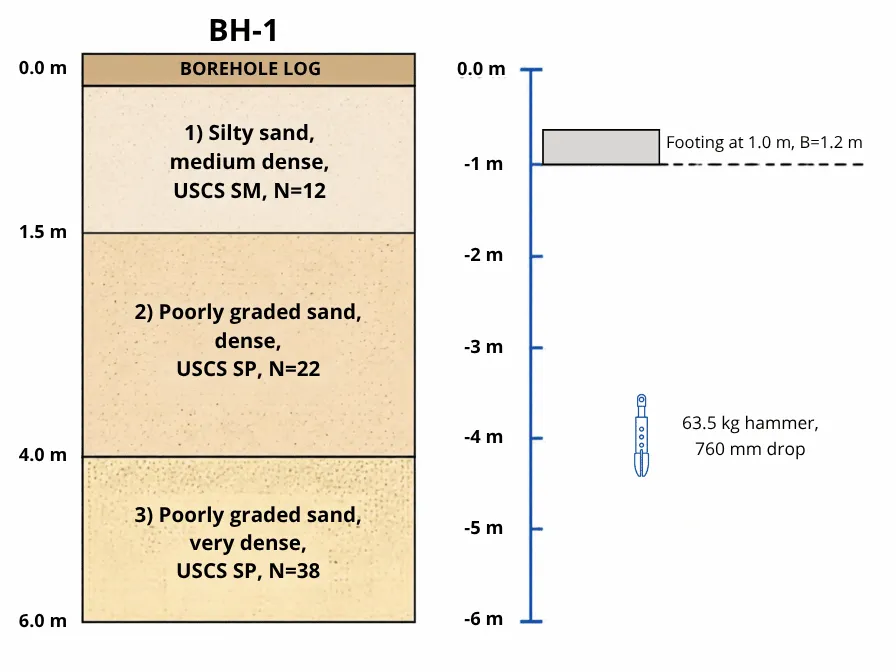
The footing will sit at 1.0 m depth in the medium-dense silty sand (raw N = 12).
Step 1 — correct N for hammer energy. Correlations that use the SPT blow count usually take the 60% energy form,
with the hammer energy ratio in percent. With a standard safety hammer at %, . The soil is shallow and the depth dependence enters through a separate overburden factor in some correlations; the settlement-based correlation below already carries that depth dependence, so feeding it an extra overburden-normalized blow count double-counts. That double-counting is the single most common way a hand calc inflates the answer.
Step 2 — the settlement-based correlation. The classic one-line estimate for a footing in sand with 25 mm of allowable settlement (Meyerhof, in the Bowles form; valid for m) is
With :
That is the settlement-based cap: at this pressure a m footing in this silty sand is expected to settle about 25 mm. It already embeds the overburden effect, so correcting N a second time is the trap to avoid.
Step 3 — the bearing-capacity route. A structural engineer typically also checks the ultimate capacity divided by a safety factor, using the general bearing equation (Terzaghi, with shape factors omitted here for simplicity):
For silty sand we take . Reading the report’s parameter table, the medium-dense silty sand is given , kN/m³. Terzaghi’s factors at are and . The surcharge at 1.0 m depth is kPa.
With a factor of safety of 3:
Step 4 — the settlement check. The two routes agree (240 vs 206 kPa), so bearing controls mildly and the design value is about 200 kPa. A quick elastic estimate confirms settlement: for kPa, m, Poisson’s ratio and a modulus of MPa, the settlement of a square footing is roughly
well within the 25 mm tolerance and consistent with the correlation’s own assumption.
Red flags on the page
Some findings in a report should stop the conversation, not just adjust a number:
- Fill without proper compaction data. Fill that was placed without testing is suspect under a footing no matter how clean it looks.
- Organic soils or peat in the foundation zone. They are compressible, often deeply so, and consolidate for years.
- Groundwater above or near the bearing level, especially if the report does not address dewatering or buoyancy.
- SPT N of single digits (say, below 5) in the top few metres under a loaded footing, or very low blow counts that the report “explains away.”
- Expansive clay listed for the bearing stratum. Seasonal shrink-swell moves footings independent of load.
- A “log of test pits” but no in-situ or lab strength data — you have a description, not a design parameter.
When you see any of these, the report should have already proposed a mitigation (deeper footing, piles, ground improvement, moisture control). If it documents the hazard but does not resolve it, that is a gap to raise with the geotechnical engineer, not a detail to skate over.
How much a report costs and why
Costs vary widely with region, depth, number of borings, and how fast you need it. For a typical residential or light commercial lot with 2–4 shallow borings, a common range in the US is roughly 4,000, with riskier or larger sites costing more. Groundwater monitoring, deep borings, seismic site-class work, or contaminated-ground evaluation all add to it.
What you are paying for is the parameters the structural engineer needs, and the opinion of a licensed engineer on a site you cannot see. Skimping here by ordering fewer or shallower borings does not save money in the end: it just moves the risk and the cost into the foundation, where changes are expensive.
Frequently asked questions
Do I always need a geotechnical report? For any structure that transfers meaningful load to the ground, yes in practice. Many jurisdictions require one for permitting on new construction. For small, light, and well-understood structures in stable ground, some codes allow a default assumed bearing pressure, but that is a risk decision, not a technical one.
What is the difference between a factual and an interpretive report? A factual (or data) report presents the field and laboratory results without interpretation. An interpretive report adds the engineering evaluation and recommendations. Most projects need the interpretive version; the factual one is sometimes used for design-build where the design team does its own reading.
How deep do the borings need to be? Enough to reach the stratum the foundation will bear on plus the zone of influence below it, and deep enough to catch soft layers that settlement could mobilize. The geotechnical engineer sets this from the project loads and the site; a rule of thumb for footings is exploration to several times the footing width, but the site conditions govern.
Can I use the SPT value directly to pick a bearing pressure? Only as a rough, first-pass screening. The raw N needs the overburden and energy corrections, and the final answer needs a settlement check. When a report gives you its own allowable pressure, use that number.
Putting it together
Reading a geotechnical report is pattern recognition, not a geotechnical degree. Find the boring logs, find the parameter table, check the recommended foundation and the allowable pressure, check whether settlement was addressed, and watch for the red flags. When the numbers are not in the report, they have to be computed honestly (with the settlement check, not just a capacity formula), and the tools on this site can run the bearing and settlement checks with every parameter in view.
The worst possible way to use a geotechnical report is to skim it for the highest allowable pressure and design against that. The people who built the report built it so you would not have to guess.
Sign up free and run your first foundation check.