

Hydrometer test of soil: ASTM D7928 procedure and formulas
How to run the hydrometer test on a fine-grained soil per ASTM D7928, with a 151H or 152H hydrometer: Stokes' law, percent finer, and the report.
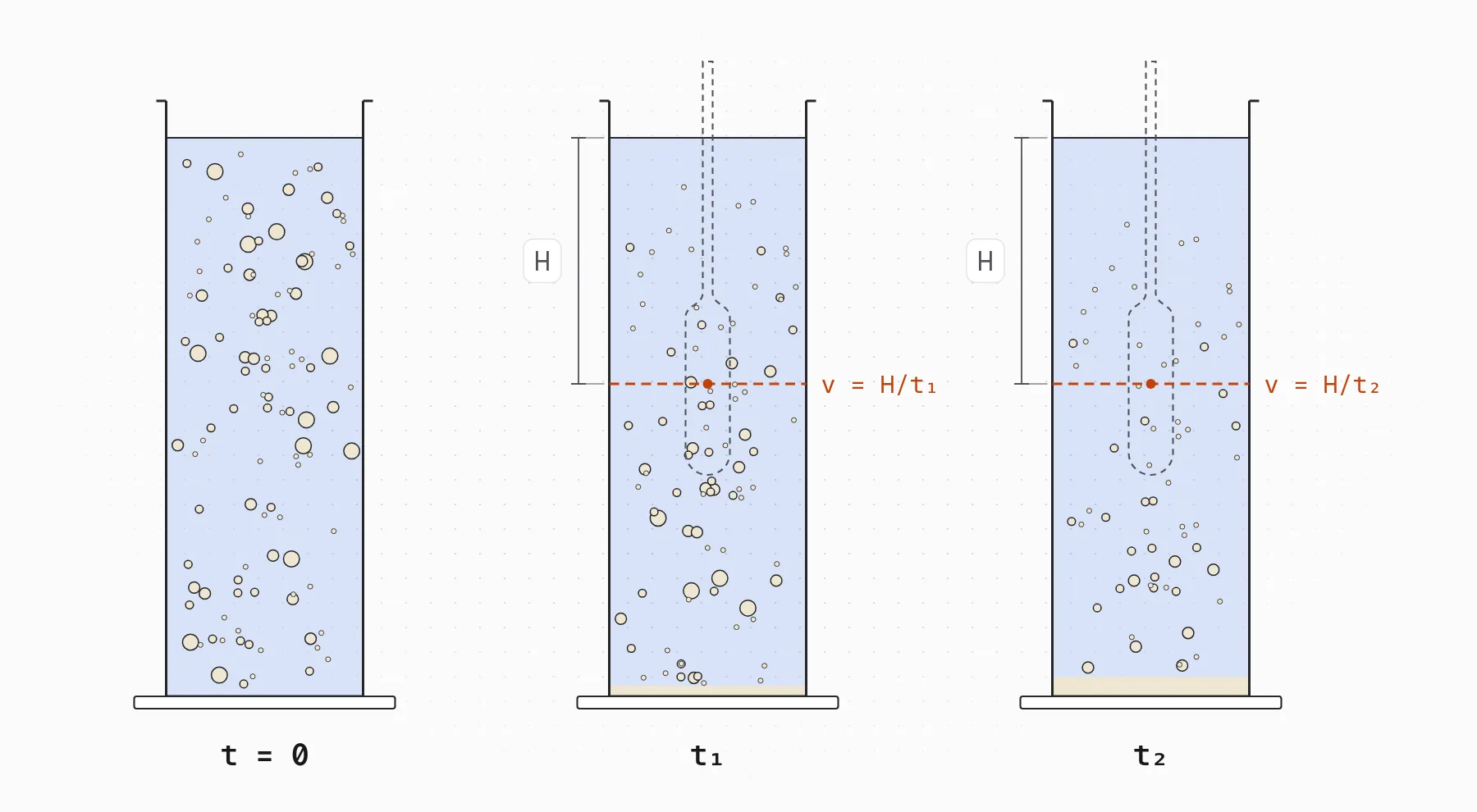
The hydrometer test gives the particle-size distribution of the part of a soil finer than the No. 200 (75 µm) sieve: the silt and clay that sieves can’t separate. The soil is dispersed in water, and a hydrometer reads the density of the suspension as the particles settle. Stokes’ law turns each reading’s time into a particle diameter, and the reading itself into the percentage of soil still finer than that diameter. ASTM D7928 is the current standard for the test. It replaced ASTM D422, which was withdrawn in 2016.
The result completes the grain-size curve from a sieve analysis (ASTM D6913) below 75 µm. It gives the clay-size fraction, finer than 2 µm, which together with the plasticity index from the Atterberg limits gives the clay’s activity. The gradation of the silt and clay also helps judge a soil’s susceptibility to frost.
Hydrometer test calculator
Calculator · ASTM D7928
Hydrometer used
The two read differently and each has its own formulas. The 151H reads the suspension's specific gravity, from 0.995 to 1.038: write it as read, like 1.0226. The 152H reads grams of soil per liter, from −5 to 60: write it in g/L, like 36.5.
Changing the hydrometer changes the example: they aren't the same numbers. The 151H's effective depth comes from its calibration: the two marks below, their distances and the meniscus correction (ASTM D7928).
Hydrometer readings
Each reading as its scale gives it, at the top of the meniscus: a specific gravity, like 1.0226. Each reading's temperature gives the water's viscosity and density for Stokes' law. The water-with-dispersant-only reading is what's subtracted to know how much material is still in suspension; if you took it in the second cylinder with each reading, at its temperature, as the standard asks, write it in its row. An empty cell takes the suspension's value, below: the starting temperature holds for the readings up to 30 minutes.
| Reading | Time(min) | Hydrometer reading | Temperature(°C) | Dispersant only |
|---|---|---|---|---|
| #1 | ||||
| #2 | ||||
| #3 | ||||
| #4 | ||||
| #5 | ||||
| #6 | ||||
| #7 | ||||
| #8 | ||||
| #9 |
The first nine rows are the times the standard asks for. You can add your own: 2880 min, or others your test recorded.
The hydrometer's constants
From the instrument's calibration: the two readings at the meniscus marks, their distances to the bottom and the meniscus correction. With them each reading is corrected into its effective depth.
Suspension
The water-with-dispersant reading is the zero: what's above it is the material in suspension. The temperature gives the water's viscosity and density for Stokes' law; the 151H's percent uses water's density at 20 °C, its calibration's.
As a specific gravity, like the readings: 1.0022.
Each reading's without a temperature of its own. The water's viscosity and density come from it.
Only if the specimen was what passed the No. 10 or the No. 200: it refers each percent to the whole soil. Empty, the specimen is the whole soil.
9 readings cover 0.0468 to 0.0014 mm; 35.1 % of the soil is still in suspension at the end, the material finer than sieving can measure. At 20 °C: μ = 1.0016 cP and ρw = 0.99821 g/cm³, for Stokes' law. 0.99821 g/cm³, water's at 20 °C: the 151H is adjusted at that temperature, so its reading turns into a density with it, whatever the test's
Each reading and its equivalent diameter
| Quantity | Value |
|---|---|
| 1 mindepth 10.70 cm · 20 °C: μ 1.0016 cP, ρw 0.99821 | 0.0468mm |
| 2 mindepth 10.89 cm · 20 °C: μ 1.0016 cP, ρw 0.99821 | 0.0334mm |
| 4 mindepth 11.09 cm · 20 °C: μ 1.0016 cP, ρw 0.99821 | 0.0238mm |
| 8 mindepth 11.37 cm · 20 °C: μ 1.0016 cP, ρw 0.99821 | 0.0171mm |
| 15 mindepth 11.65 cm · 20 °C: μ 1.0016 cP, ρw 0.99821 | 0.0126mm |
| 30 mindepth 11.93 cm · 20 °C: μ 1.0016 cP, ρw 0.99821 | 0.0090mm |
| 60 mindepth 12.24 cm · 20 °C: μ 1.0016 cP, ρw 0.99821 | 0.0065mm |
| 240 mindepth 13.00 cm · 20 °C: μ 1.0016 cP, ρw 0.99821 | 0.0033mm |
| 1440 mindepth 13.76 cm · 20 °C: μ 1.0016 cP, ρw 0.99821 | 0.0014mm |
This calculator is offered for information and technical support. It doesn't replace professional judgment or the reviews due, and its use is the user's responsibility.
The calculator also has a page of its own, to keep at hand: the hydrometer analysis calculator.
What the hydrometer analysis of soil measures
A particle falling through still water reaches a constant speed that grows with the square of its diameter. That is Stokes’ law, and it is why the suspension sorts itself by size: after a time , every particle larger than a certain diameter has already fallen past a given depth, and every smaller one is still there in the same concentration it had at the start.
The hydrometer measures the density of the suspension around its bulb. The distance from the surface of the suspension to the bulb’s center of buoyancy is the effective depth . At time , the particles that are still at depth are those that fall more slowly than , so the reading tells how much soil is finer than the diameter whose settling velocity is .
Stokes’ law formula
For a sphere settling in a fluid, the terminal velocity is:
Where:
- is the settling velocity, in cm/s.
- is the density of the soil particles, in g/cm³.
- is the density of water at the test temperature, in g/cm³.
- is the acceleration due to gravity, in cm/s².
- is the particle diameter, in cm.
- is the dynamic viscosity of water at the test temperature, in poise (g/(cm·s)).
Solving for with and gives the diameter for each reading, in the calculations below.
The law assumes smooth spherical particles of the same density, no interference between them, no currents in the cylinder, and laminar flow. Fine silt and clay particles are usually plate-shaped, so the result is an equivalent diameter: the size of a sphere that would settle at the same speed. ASTM D7928 gives the method’s range as roughly 100 µm down to 0.1 µm. The time needed to get a stable first reading sets the upper limit, and the length of the test sets the lower one.
The 151H and 152H hydrometers
ASTM D7928 works with either of the two soil hydrometers in ASTM E100, both adjusted at 20 °C. They measure the same thing on different scales, so each has its own equations:
| Hydrometer | Scale | Range | Division | Capacity in 1000 mL |
|---|---|---|---|---|
| 151H | Specific gravity of suspension | 0.995 to 1.038 | 0.001 | about 45 g of soil |
| 152H | Grams of soil per liter | −5 to 60 g/L | 1 g/L | about 55 g of soil |
The 152H’s scale assumes soil with ; for any other the percent finer takes the correction factor (calculation 3). The capacity is the most dry soil the hydrometer can take in 1000 mL of suspension. With more soil, the suspension is too dense for the scale and the readings are no longer reliable.
Equipment
- Type 151H or 152H hydrometer (ASTM E100).
- Sedimentation cylinder with a 1000 mL mark.
- A second cylinder of test water with the same dispersant, for the dispersant correction and for keeping the hydrometer between readings.
- Stirring apparatus (a soil dispersion mixer) with its dispersion cup.
- Agitator for mixing the suspension in the cylinder, or a rubber stopper to mix it by tipping.
- Thermometer readable and accurate to 0.5 °C or better.
- Constant-temperature water bath, needed only when the room can’t keep the suspension’s temperature steady (see step 9).
- No. 10 (2.0 mm) and No. 200 (75 µm) sieves.
- Balance.
- Drying oven at 110 ± 5 °C, as in ASTM D2216.
- Glass beaker of about 250 mL, oven-drying containers, a wash bottle, and a timer.
- Sodium hexametaphosphate as the dispersant.
- Isopropyl alcohol, a few drops, to break up foam.
Calibrating the hydrometer
Three numbers come from the hydrometer and the test water before the test.
The suspension is opaque, so the hydrometer is always read at the top of the meniscus, where the liquid climbs the stem. To get the meniscus correction, , put the hydrometer in clear test water with dispersant and read both the top of the meniscus and the level where the water surface meets the stem. Their difference is , in the hydrometer’s units. It is positive for both hydrometers.
The effective depth depends on where the water surface crosses the stem. For the 151H, calibrate the hydrometer as the standard specifies to get the effective depths and of two marks on its scale, whose readings are and . For a 152H of the standard dimensions, the effective depth comes from a formula on its reading (calculation 4).
The dispersant makes the water denser. The dispersant correction, , is the reading at the top of the meniscus in test water with the same concentration of dispersant as the suspension, at the same temperature. Both cylinders are read the same way, so subtracting removes the effect of the dispersant, of the water’s temperature, and of the meniscus in one step.
Hydrometer test procedure (ASTM D7928)
ASTM D7928 prepares the specimen in one of two ways. Moist preparation is the default and the one used for referee testing: the soil is never dried before the test. Air-dried preparation is allowed only when the soil arrives air-dried. Oven-dried soil can’t be used. The suspension is mixed in the cylinder with an agitator, which the standard prefers, or by tipping the cylinder by hand.
The method doesn’t apply to soils with fibrous peat, to soils with less than about 5% fines, to materials with extraneous matter such as oil, asphalt, or wood, or to materials with cement, fly ash, lime, or other stabilizers. Soils that flocculate, friable soils, and soils that won’t disperse need adapting the method and documenting how.
Preparing the specimen
- Work out the mass of moist soil to take, so that the dry fines don’t exceed the hydrometer’s capacity:
Where:
- is the mass of moist soil, in g.
- is the hydrometer’s capacity: 45 g for the 151H and 55 g for the 152H.
- is the estimated percent passing the No. 200 (75 µm) sieve.
- is the estimated water content, in %.
For example, with , , and a 151H, g. Specimens typically weigh 50 to 60 g. ASTM D7928 asks for at least 15 g of fines in the specimen.
- Moist preparation: keep the soil moist and work it through the No. 10 (2.0 mm) sieve with a rubber scraper. Air-dried preparation: break up the lumps with a mortar and a rubber-tipped pestle until they pass the No. 10 sieve.
- Take the sedimentation specimen, of about the mass , and record its mass. Take a second, similar specimen for the water content.
- Put the specimen in the beaker and add test water and about 5 g of sodium hexametaphosphate, recording the exact mass of dispersant. Stir until all the soil is wet and let it soak for the time the standard specifies.
Dispersing and conditioning
- Rinse the slurry into the dispersion cup, add water until it’s about half full, and mix it with the stirring apparatus for about 1 minute.
- Wash all of the slurry into the sedimentation cylinder with the wash bottle and fill it to the 1000 mL mark with test water.
- Fill the second cylinder with test water and the same concentration of dispersant, and keep it next to the first.
- Cover both cylinders and let them reach a steady temperature overnight.
- Keep the room at 22 ± 5 °C. If the suspension’s temperature can change by more than 2 °C during the test, keep the cylinders in the water bath.
Taking the readings
- Mix the suspension with the agitator, with smooth up-and-down strokes from the bottom for about 1 minute, or by tipping the stoppered cylinder. Start the timer the moment mixing ends.
- If foam covers the surface and hides the meniscus, add a few drops of isopropyl alcohol.
- Take readings at 1, 2, 4, 15, 30, 60, 240, and 1440 minutes. Extra readings in between are allowed.
- About 15 to 20 seconds before each reading, lower the hydrometer gently to about where it will float and let it settle, without bobbing or spinning.
- Read the top of the meniscus to the nearest ¼ of a division and record it.
- Withdraw the hydrometer in one steady motion over 5 to 10 seconds. Rinse it, dry it, and put it back in the second cylinder. Don’t leave it in the suspension between readings.
- After each reading, measure the suspension’s temperature without disturbing it. The starting temperature holds for the readings up to 30 minutes.
- Read the dispersant correction in the second cylinder at the temperature of each reading.
- Keep the cylinders covered between readings so that the water doesn’t evaporate.
After the last reading
- Transfer all of the suspension to an oven-drying container of known mass, rinsing the cylinder so that no soil stays behind, and oven-dry it. The dry mass includes the dispersant.
- Wash the dried soil over the No. 200 (75 µm) sieve, oven-dry what stays on it, and record that mass.
Hydrometer test calculations
- Get the dry mass of the specimen, , from the oven-dried suspension, subtracting the dispersant:
Where:
- is the dry mass of soil and dispersant from step 19, in g.
- is the mass of dispersant added in step 4, in g.
- As a check, get a second estimate of the dry mass, , from the moist mass of the specimen and the water content of the companion specimen, and compare the two:
Where:
- is the moist mass of the sedimentation specimen, in g.
- is the water content of the companion specimen, in %.
- is the error in the dry mass, in %.
- Calculate the percent finer, , at each reading . With the 151H:
With the 152H:
Where:
- is the percent finer at reading , in %.
- is the specific gravity of the soil solids, from ASTM D854 (see the specific gravity lesson).
- is the volume of the suspension, 1000 cm³.
- is the dry mass of the specimen, in g.
- is the density of water at the hydrometer’s calibration temperature, 20 °C, in g/cm³.
- is the hydrometer reading at the top of the meniscus: a specific gravity on the 151H (for example 1.0226), grams per liter on the 152H.
- is the dispersant correction at the temperature of reading , in the same units: the reading in the second cylinder, with water and the same amount of dispersant as the suspension, without soil.
- is the 152H’s correction for specific gravity. The constant makes for the the 152H’s scale assumes.
- Calculate the effective depth, , at each reading. For the 151H, interpolate between the two calibrated marks, using the reading corrected for the meniscus:
Where:
- is the effective depth at reading , in cm.
- and are the readings of the two calibrated marks, and and their effective depths, in cm.
- is the meniscus correction.
For a 152H of the standard dimensions, with the reading in g/L:
This line comes from ASTM D422’s effective depth, : is the distance from the top of the bulb to the reading’s mark (10.5 cm at 0 g/L, 2.3 cm at 50 g/L), cm is the bulb’s length, cm³ is its volume, and cm² is the cylinder’s cross-sectional area. The term accounts for the rise of the suspension when the bulb goes in. Rischio’s calculator takes as read. Some lab manuals, such as the University of Texas at Arlington’s in the references, add to the reading first. With of about 1 g/L, the depth changes by 0.16 cm and the diameter by less than 1%.
- Calculate the particle diameter, , at each reading with Stokes’ law:
Where:
- is the particle diameter at reading , in mm. The factor 10 turns centimeters into millimeters.
- is the viscosity of water at the temperature of the reading, in poise (1 cP = 1 mPa·s = 0.01 poise).
- is the density of water at the temperature of the reading, in g/cm³.
- is the acceleration due to gravity, 980.7 cm/s².
- is the effective depth, in cm.
- is the elapsed time since mixing ended, in seconds.
ASTM D422 wrote the same law with the time in minutes, , and tabulated in for each temperature and . The two forms differ by about 0.1%.
- If the specimen was only the part of the soil passing a separation sieve (the No. 10 or the No. 200), multiply each by that sieve’s percent passing from the sieve analysis, divided by 100, to refer it to the whole sample. ASTM D6913 sets how the sieve and sedimentation results are combined.
Worked example (151H)
The calculator’s 151H example: , g, cm³, water at 20 °C ( cP and g/cm³), calibration at cm and at cm, , and . The 1-minute reading is :
-
cm.
-
.
-
mm.
So 75.4% of the soil is finer than 0.047 mm.
Report
For each specimen tested, report:
-
The hydrometer used (151H or 152H), the preparation method (moist or air-dried), the mixing method, the dispersant and its mass, and the used, saying whether it was measured or assumed.
-
For each reading: the elapsed time, the reading, the temperature, the effective depth, the diameter, and the percent finer.
-
The grain-size curve, with the percent finer on the y axis and the particle diameter in millimeters on a logarithmic x axis. When the test is combined with a sieve analysis, show both parts on one curve and say which part came from each test.
-
The percent finer than 2 µm (the clay-size fraction) and the percent passing the No. 200 (75 µm) sieve.
-
The diameters , , and , where the curve reaches 60%, 30%, and 10% passing, and with them the coefficients of uniformity and curvature, when the curve reaches those percentages:
- The error in the dry mass, .
In high-plasticity clays, the water bound to the particle surfaces is denser than free water and pushes the curve up. ASTM D7928 doesn’t correct for it, and a percent finer above 100% is reported as measured.
Common mistakes
- A specimen with more dry soil than the hydrometer’s capacity (45 g for the 151H, 55 g for the 152H) makes the suspension too dense for the scale. Repeat the test with a smaller specimen.
- The percent finer must go down with time. If a reading goes up, the particles are flocculating: the dispersant isn’t working, and the test has to be repeated.
- A negative percent finer means the reading fell below the dispersant correction, usually in the last readings. Check , the temperatures, and that both cylinders were read at the top of the meniscus.
- The 151H reads specific gravities such as 1.0226, and the 152H grams per liter such as 36.5. A 151H reading written in thousandths (22.6), or one hydrometer’s readings put into the other’s equations, gives meaningless results.
- Bobbing the hydrometer, leaving it in the suspension between readings, or letting the temperature drift stirs up particles that should be settling.
- Oven-dried soil isn’t allowed. Drying can make plastic clays hard to disperse, and ASTM D7928 lists dried plastic clays among the soils that may not disperse readily.
References
- ASTM D7928-21e1, Standard Test Method for Particle-Size Distribution (Gradation) of Fine-Grained Soils Using the Sedimentation (Hydrometer) Analysis. ASTM International. Scope and significance: astm.org/d7928-21e01.html.
- ASTM D422-63(2007)e2, Standard Test Method for Particle-Size Analysis of Soils (withdrawn 2016). ASTM International.
- ASTM E100, Standard Specification for ASTM Hydrometers. ASTM International.
- Gilson Company. What is the Hydrometer Test of Soil?
- University of Alabama, CE 340. Lab 3: Hydrometer.
- Hossain, M. S., Islam, M. A., Badhon, F. F., & Imtiaz, T. (2021). Properties and Behavior of Soil: Online Lab Manual, chapter 4, Hydrometer Analysis. Mavs Open Press, University of Texas at Arlington. CC BY-NC 4.0.
- Geosystem Software. Grain Size Distribution: Documentation of Calculations.
- Brannan. ASTM soil hydrometers, data sheet ASTMH003.
- Germaine, J. T., & Germaine, A. V. (2009). Geotechnical Laboratory Measurements for Engineers. Wiley.