

Unified Soil Classification System (USCS)
Classify soils with the Unified Soil Classification System (USCS) per ASTM D2487, with group symbols and names, the plasticity chart, Cu, and Cc.
Soil classification sorts soils into groups that behave in similar ways. The Unified Soil Classification System (USCS) is the one most used in geotechnical engineering, because it gives a standard method based on two things a lab can measure: the soil’s grain-size distribution and its plasticity. Its laboratory version is ASTM D2487, which assigns every soil a group symbol, such as CL or SP-SM, and a group name, such as “sandy lean clay.”
The USCS is used in foundation design, slope stability, and earthworks because it describes a soil in an objective, repeatable way, and two labs that run the same tests reach the same group. This lesson covers the criteria of ASTM D2487, the plasticity chart, the tests that feed the classification, and the procedure step by step.
USCS calculator
Calculator · ASTM D-2487
CL
Sandy lean clay
LL = 34 < 50. PI = 12 above the A-line (PI = 10.2). Retained on the #200 = 38 % (sand 29 %, gravel 9 %), 30 % or more and sand ≥ gravel: “sandy”; gravel 9 % < 15 %
This calculator is offered for information and technical support. It doesn't replace professional judgment or the reviews due, and its use is the user's responsibility.
The calculator also has a page of its own, to keep at hand: the USCS classification calculator. How the classification reads in a site investigation is in how to read a geotechnical report.
What is the Unified Soil Classification System?
The Unified Soil Classification System grew out of the airfield classification that Arthur Casagrande developed in the early 1940s. Several U.S. government agencies, among them the Bureau of Reclamation and the Corps of Engineers, adopted a modified version in 1952, and ASTM D2487 is its standard version today. The same system has a field counterpart, ASTM D2488, which describes and identifies soils by sight and touch; D2487 is the one to use when the classification must be precise, because it rests on laboratory tests.
D2487 classifies naturally occurring mineral and organo-mineral soils from three measurements: the particle-size distribution, the liquid limit (LL), and the plasticity index (PI). It works on the material that passes the 3 in (75 mm) sieve. Larger particles are taken out before testing, but their percentage is recorded and reported.
The system uses these particle sizes:
| Fraction | Size range |
|---|---|
| Boulders | Larger than 300 mm (12 in) |
| Cobbles | 75 mm (3 in) to 300 mm (12 in) |
| Coarse gravel | 19 mm (3/4 in) to 75 mm (3 in) |
| Fine gravel | 4.75 mm (No. 4) to 19 mm (3/4 in) |
| Coarse sand | 2.00 mm (No. 10) to 4.75 mm (No. 4) |
| Medium sand | 0.425 mm (No. 40) to 2.00 mm (No. 10) |
| Fine sand | 0.075 mm (No. 200) to 0.425 mm (No. 40) |
| Fines (silt and clay) | Passing the 0.075 mm (No. 200) sieve |
USCS soil classification
The USCS divides soils into three major divisions:
- Coarse-grained soils: more than 50% of the dry mass is retained on the No. 200 sieve. They are gravels or sands, and their group depends on how much fines they have. With less than 5% fines, the gradation decides: well graded (GW, SW) or poorly graded (GP, SP). With more than 12% fines, the plasticity of the fines decides: silty (GM, SM) or clayey (GC, SC). Between 5% and 12% fines, both count, and the soil gets a dual symbol such as GW-GM or SP-SC.
- Fine-grained soils: 50% or more passes the No. 200 sieve. They are silts and clays, told apart by where their liquid limit and plasticity index fall on the plasticity chart: lean clay (CL), silt (ML), fat clay (CH), elastic silt (MH), and, when organic matter changes the liquid limit, organic soils (OL, OH).
- Highly organic soils: peat (PT), made mostly of plant tissue in various stages of decomposition. It is identified by sight and smell and is not put through the rest of the procedure.
The first letter of the group symbol says what the soil mainly is:
- G: gravel
- S: sand
- M: silt
- C: clay
- O: organic
- PT: peat
The second letter describes its gradation or its plasticity:
- W: well graded
- P: poorly graded
- M: silty fines
- C: clayey fines
- L: low plasticity (LL less than 50)
- H: high plasticity (LL of 50 or more)
These are the 15 basic groups, with the group names of ASTM D2487:
| Group symbol | Group name |
|---|---|
| GW | Well-graded gravel |
| GP | Poorly graded gravel |
| GM | Silty gravel |
| GC | Clayey gravel |
| SW | Well-graded sand |
| SP | Poorly graded sand |
| SM | Silty sand |
| SC | Clayey sand |
| ML | Silt |
| CL | Lean clay |
| OL | Organic clay or organic silt |
| MH | Elastic silt |
| CH | Fat clay |
| OH | Organic clay or organic silt |
| PT | Peat |
Dual symbols
D2487 gives a soil two symbols joined by a hyphen in two cases: a coarse-grained soil with 5 to 12% fines, and fines whose limits plot in the hatched CL-ML zone of the plasticity chart.
| Dual symbol | Group name |
|---|---|
| GW-GM | Well-graded gravel with silt |
| GW-GC | Well-graded gravel with clay (or silty clay) |
| GP-GM | Poorly graded gravel with silt |
| GP-GC | Poorly graded gravel with clay (or silty clay) |
| SW-SM | Well-graded sand with silt |
| SW-SC | Well-graded sand with clay (or silty clay) |
| SP-SM | Poorly graded sand with silt |
| SP-SC | Poorly graded sand with clay (or silty clay) |
| GC-GM | Silty, clayey gravel |
| SC-SM | Silty, clayey sand |
| CL-ML | Silty clay |
With 5 to 12% fines that plot as CL-ML, the second symbol is GC or SC, and the name says “with silty clay.” With more than 12% such fines, the symbol is GC-GM or SC-SM.
When the results put a soil close to the boundary of another group, D2487 allows a borderline symbol, two symbols separated by a slash, such as CL/CH. It is optional, and the first symbol is always the one the criteria give.
Colombia’s INV E-181 uses the same symbols, with Spanish names based on compressibility: CL, for example, is called “low-compressibility clay” there.
Group names: “with sand,” “sandy,” “with gravel”
The symbol alone doesn’t say everything about a soil, so D2487 completes the group name with what else it contains.
In a coarse-grained soil:
- A gravel with 15% sand or more adds “with sand” (poorly graded gravel with sand, GP).
- A sand with 15% gravel or more adds “with gravel” (clayey sand with gravel, SC).
- If the fines are organic, add “with organic fines.”
In a fine-grained soil, the modifier depends on how much is retained on the No. 200 sieve:
- Less than 15% retained: no modifier (lean clay, CL).
- From 15 to 29% retained: add “with sand” or “with gravel,” whichever is greater; if they are equal, “with sand” (silt with gravel, ML).
- 30% or more retained: put “sandy” or “gravelly” in front, whichever is greater; if they are equal, “sandy.” If the other coarse fraction reaches 15%, add it at the end (sandy lean clay with gravel, CL).
In any soil, if the field sample had cobbles or boulders, the name ends “with cobbles” or “with cobbles and boulders.”
Plasticity chart
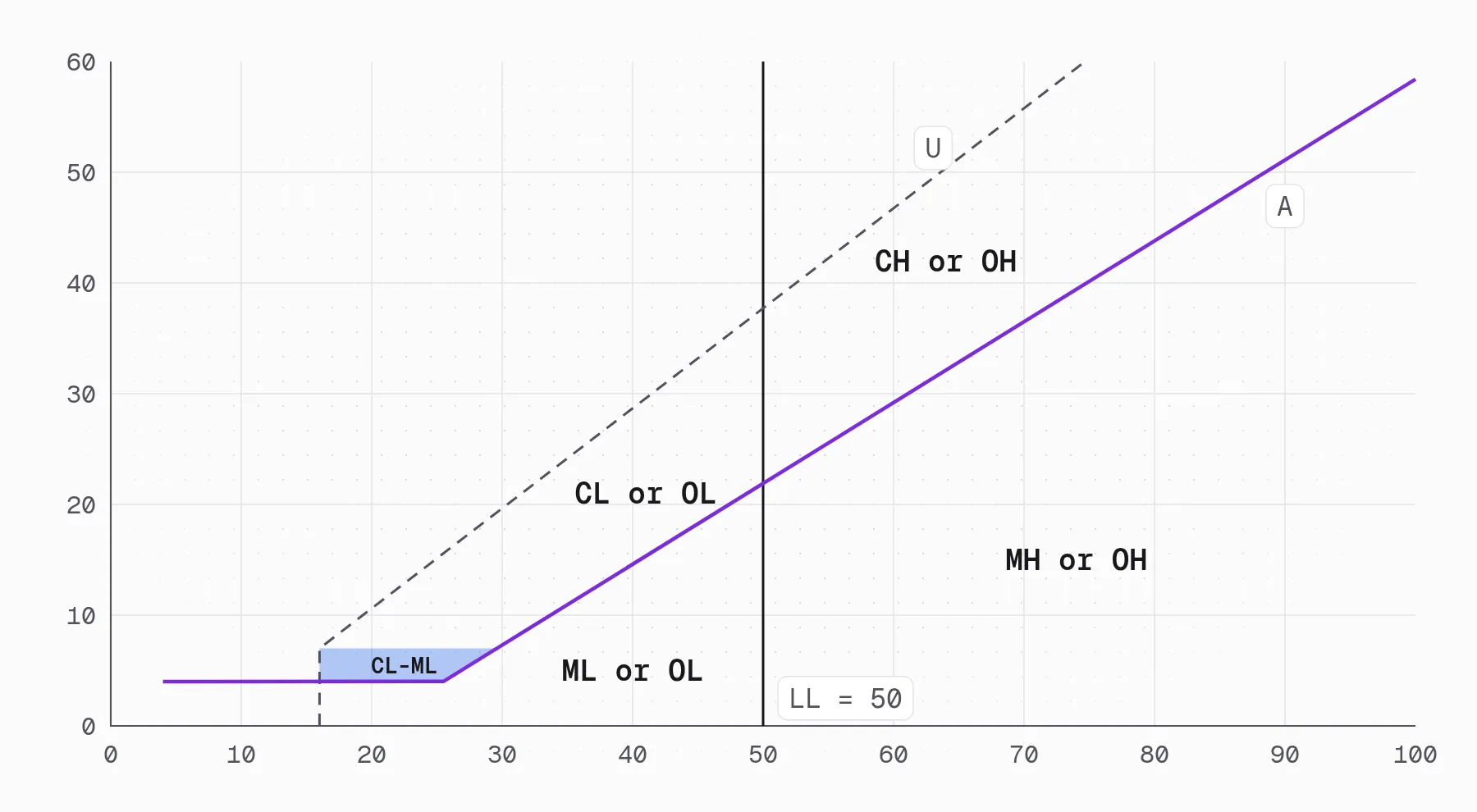
The plasticity chart, also called the Casagrande chart, classifies fine-grained soils and the fines of coarse-grained soils. It plots the plasticity index against the liquid limit:
Where:
- = plasticity index (%)
- = liquid limit (%)
- = plastic limit (%)
Both limits come from the Atterberg limits test.
Four lines divide the chart:
- The A-line separates clays (on or above it) from silts (below it). It runs horizontally at up to , and from there it follows:
- The vertical line at separates low plasticity (L) from high plasticity (H). A soil with an LL of exactly 50 is high plasticity.
- The hatched CL-ML zone covers on or above the A-line. A soil that plots there is a silty clay, CL-ML.
- The U-line is the approximate upper limit of natural soils. It is vertical at up to , and from there it follows:
Where and are the plasticity index on the A-line and on the U-line at a given liquid limit (%).
The U-line doesn’t classify anything: a point above it or to its left is unusual for a natural soil, and the test results should be checked before classifying. A point that falls exactly on the A-line counts as clay. For example, at the A-line is at and the U-line at .
Coefficients of uniformity and curvature
A coarse-grained soil with 12% fines or less is graded with two coefficients read from its grain-size curve, from a sieve analysis:
Where:
- = coefficient of uniformity
- = coefficient of curvature
- , , = particle diameters at which 10%, 30%, and 60% of the soil passes on the cumulative grain-size curve (mm)
A soil is well graded when:
- Gravel: and
- Sand: and
If it misses either condition, it is poorly graded. With 5 to 12% fines, the curve may not reach 10% passing on the sieves; then can be found by extending the curve.
Organic soils and peat
A fine-grained soil is organic when its organic matter is enough to change its properties. D2487 checks it with the liquid limit. If the soil is dark and smells organic, run a second liquid limit test on a specimen oven-dried at 110 ± 5 °C to constant mass (usually overnight), and compare it with the liquid limit of the specimen that was never oven-dried:
Where:
- = liquid limit of the oven-dried specimen (%)
- = liquid limit of the specimen that was not oven-dried (%)
If the ratio is below 0.75, the soil is organic: OL if is less than 50, and OH if it is 50 or more. Its name depends on the plasticity chart:
- OL: organic clay if and the point is on or above the A-line; organic silt if or the point is below the A-line.
- OH: organic clay if the point is on or above the A-line; organic silt if it is below.
Peat (PT) is classified without tests: a soil made mainly of plant tissue in various stages of decomposition, dark brown to black, with an organic odor, a spongy consistency, and a texture from fibrous to amorphous.
Tests and equipment
To classify a soil with D2487 you need:
- The particle-size distribution of the material passing the 3 in sieve, by sieve analysis (ASTM D6913). It gives the percentages of gravel, sand, and fines, and the curve for and . A hydrometer analysis is not needed to classify the soil.
- The liquid limit and the plastic limit of the material passing the No. 40 sieve, by the Atterberg limits test (ASTM D4318).
- A second liquid limit on an oven-dried specimen, only when the soil may be organic.
Which tests apply depends on the fines content you expect:
| Estimated fines | What is needed |
|---|---|
| Less than 5% | Grain-size curve of the coarse fraction, for and |
| 5% to 15% | Grain-size curve, liquid limit, and plasticity index |
| 15% or more | Percentages of gravel, sand, and fines, liquid limit, and plasticity index |
For cohesive soils that have never dried out and for organic soils, D2487 prefers the wet preparation method, in which the soil is never dried below its natural water content before the limits are run, because drying can change the limits of these soils.
The equipment is that of each test, plus:
- A set of sieves that includes at least 3 in, 3/4 in, No. 4, No. 10, No. 40, and No. 200, with others as needed to define the curve
- A drying oven that holds 110 ± 5 °C
- A plasticity chart and a cumulative grain-size curve sheet, to plot the results
Classification procedure (ASTM D2487)
- Look for peat. If the sample is mainly plant tissue, dark, spongy, and smells organic, classify it as peat (PT) and stop.
- Remove the oversize. Take out the particles retained on the 3 in (75 mm) sieve, and record their percentage by dry mass and the maximum particle size.
- Run the tests that apply (see Tests and equipment).
- Decide whether the soil is coarse or fine. If 50% or more passes the No. 200 sieve, it is a fine-grained soil; otherwise, it is a coarse-grained soil.
- Classify it with the criteria below, for coarse-grained or fine-grained soils.
- Complete the group name with “with sand,” “sandy,” “with gravel,” and the rest, by the rules in the group names section above.
Coarse-grained soils
First decide whether the soil is gravel or sand. What counts is the coarse fraction, the part retained on the No. 200 sieve, and not the whole sample. From the percentages passing the No. 4 and No. 200 sieves:
Where:
- = percentage of the sample passing the No. 4 sieve (%)
- = percentage of the sample passing the No. 200 sieve (%)
- , , = percentages of gravel, sand, and fines in the sample (%)
If more than half of the coarse fraction is retained on the No. 4 sieve (), the soil is gravel (G). If 50% or more of the coarse fraction passes the No. 4 sieve (), it is sand (S).
Then the fines content decides which criterion applies. In the trees, “fines ML or MH” means the fines plot below the A-line or have , and “fines CL or CH” means they plot on or above the A-line with .
Gravels (G)
- Gravels (G)
- Less than 5% fines
- GW and
- GP , or , or
- 5 to 12% fines
- GW-GM well graded, fines ML or MH
- GW-GC well graded, fines CL, CH, or CL-ML
- GP-GM poorly graded, fines ML or MH
- GP-GC poorly graded, fines CL, CH, or CL-ML
- More than 12% fines
- GM fines ML or MH
- GC fines CL or CH
- GC-GM fines CL-ML
- Less than 5% fines
Sands (S)
- Sands (S)
- Less than 5% fines
- SW and
- SP , or , or
- 5 to 12% fines
- SW-SM well graded, fines ML or MH
- SW-SC well graded, fines CL, CH, or CL-ML
- SP-SM poorly graded, fines ML or MH
- SP-SC poorly graded, fines CL, CH, or CL-ML
- More than 12% fines
- SM fines ML or MH
- SC fines CL or CH
- SC-SM fines CL-ML
- Less than 5% fines
Fine-grained soils
A fine-grained soil is classified by its liquid limit, by where its point falls on the plasticity chart, and by whether it is organic ().
Liquid limit less than 50
-
- Inorganic
- CL and on or above the A-line
- CL-ML and on or above the A-line
- ML or below the A-line
- Organic
- OL organic clay: and on or above the A-line
- OL organic silt: or below the A-line
- Inorganic
Liquid limit 50 or more
-
- Inorganic
- CH on or above the A-line
- MH below the A-line
- Organic
- OH organic clay: on or above the A-line
- OH organic silt: below the A-line
- Inorganic
Example
A soil has 62% passing the No. 200 sieve and 91% passing the No. 4 sieve, an LL of 34, a PI of 12, and no organic matter (the calculator’s example).
- 62% passes the No. 200, which is 50% or more: it is a fine-grained soil.
- : low plasticity.
- The A-line at : . The PI of 12 is above it and greater than 7, so the group symbol is CL, lean clay. The U-line is at , well above the point, so the data are plausible.
- Retained on the No. 200: . Gravel: ; sand: . With 30% or more retained and sand predominant, the name takes “sandy.” Gravel is under 15%, so nothing more is added.
The soil is a sandy lean clay (CL). The calculator gives the same full name, and works out step 4 from the percentages passing the No. 4 and No. 200 sieves.
Report
- Group name and group symbol, for example “sandy lean clay (CL)”
- Percentages of gravel, sand, and fines
- Liquid limit and plasticity index
- and , and the grain-size curve, when they were used to classify
- Percentage by dry mass of particles larger than 3 in, and the maximum particle size
- The preparation method (wet or dry) and the test standards used
- For organic soils, the liquid limits before and after oven-drying
Common mistakes
- Deciding between gravel and sand with the percentage passing the No. 4 sieve of the whole sample. The comparison is within the coarse fraction: gravel against sand, with the fines left out.
- Treating 5% or 12% fines as clean or as “with fines.” Both values fall in the 5 to 12% range and take a dual symbol.
- Calling a point on the A-line a silt, or a soil with low plasticity. Both go to the more plastic group: clay, and H.
- Running the Atterberg limits on the whole sample instead of on the material passing the No. 40 sieve.
- Oven-drying a soil that may be organic before its first liquid limit test. The organic check needs the liquid limit of the specimen that was never oven-dried.
- Classifying with a point above the U-line without checking the test first.
References
- ASTM D2487-17(2025). Standard Practice for Classification of Soils for Engineering Purposes (Unified Soil Classification System). ASTM International. https://store.astm.org/d2487-17r25.html
- Howard, A. K. (1988). Unified Soil Classification System: Test Procedures (Report GR-88-8), with procedure USBR 5000. U.S. Bureau of Reclamation. https://www.usbr.gov/tsc/techreferences/research/GR8808.pdf
- INVIAS (2013). INV E-181-13, Sistema unificado de clasificación de suelos para propósitos de ingeniería. Normas de ensayo de materiales para carreteras, Sección 100. https://caminoscomunitarios.invias.gov.co/docs/caja-herramientas/anexos-modulo-tecnico/normas-ensayo/normas_ensayo_100.pdf
- Casagrande, A. (1948). Classification and identification of soils. Transactions of the American Society of Civil Engineers, 113, 901.
- Germaine, J. T., & Germaine, A. V. (2009). Geotechnical laboratory measurements for engineers.