

Specific gravity of soil: ASTM D854 test and formula
The specific gravity of soil by ASTM D854, step by step: formula, pycnometer calibration, test procedure, correction to 20 °C and a calculator.
The specific gravity of soil, , tells you how heavy the soil grains are compared with water. The specific gravity test, ASTM D854, measures it with a water pycnometer: you weigh a calibrated flask full of water, then the same flask with a known mass of dry soil and water, and the difference between the two weighings gives the volume of the grains. Soil classification doesn’t use , but almost every phase relationship does: void ratio, porosity, degree of saturation, the zero air voids curve of a compaction test and the hydrometer analysis all need it.
Specific gravity calculator
Calculator · ASTM D854
Water density by temperature
At 20 °C water's density is 0.99821 g/cm³ and K = 1.00000, water's specific gravity relative to water at 20 °C. Click another row to change the test's temperature.
2.691
Specific gravity at 20 °C · Gs = 2.691 at 20 °C
29.6 g (307.8 − 278.2). At 20 °C its density is 0.99821 g/cm³, and at 20 °C 0.99821. 11.02 cm³, the water the soil displaces. Gs = 2.691 at the test's temperature; corrected to 20 °C, Gs₂₀ = 2.691
The test's results
| Quantity | Value |
|---|---|
| Dry soil mass · Ms307.8 − 278.2 | 29.6g |
| Water density at the test's temperature · ρ | 0.99821g/cm³ |
| Temperature coefficient · Kρ / ρ₂₀ | 1.00000 |
| Pycnometer volume · V(MBW − MB) / ρ | 249.65cm³ |
| Grains' volume · Vg(MBW + Ms − MBWS) / ρ | 11.02cm³ |
| Specific gravity at the test's temperature · GsMs / (MBW + Ms − MBWS) | 2.691 |
| Specific gravity at 20 °C · Gs₂₀K × Gs | 2.691 |
This calculator is offered for information and technical support. It doesn't replace professional judgment or the reviews due, and its use is the user's responsibility.
The calculator also has a page of its own, to keep at hand: the specific gravity calculator.
What is the specific gravity of soil?
The specific gravity of soil solids is the mass of a volume of soil grains divided by the mass of the same volume of gas-free distilled water at the same temperature. Because it compares two masses, it has no units. Labs usually report it referred to water at 20 °C. Written with densities:
where is the density of the solid particles and the density of water. Multiplying by the density of water at 20 °C gives the density of the soil solids, which hardly changes with temperature.
The pycnometer test rests on Archimedes’ principle: the grains push out a volume of water equal to their own volume, and weighing that water gives the volume. Air trapped between the grains adds volume that isn’t soil, and a change in temperature changes how much water fits in the flask; most of the procedure is there to control those two.
ASTM D854 applies to the soil solids that pass a sieve. The 2014 edition tests the fraction passing the 4.75 mm (No. 4) sieve. The 2023 edition accepts solids passing the 9.5 mm (3/8 in.) sieve or a smaller one, and keeps the split on the No. 4 sieve as the referee method. The retained fraction is tested with ASTM C127, and the two results are combined (see the calculations). The method doesn’t suit solids that the test itself would change or highly organic material that floats in water; ASTM D5550, with a gas pycnometer, can be used for those. Soils with water-soluble matter, such as salt, or with added cement or lime need special treatment.
Specific gravity formula
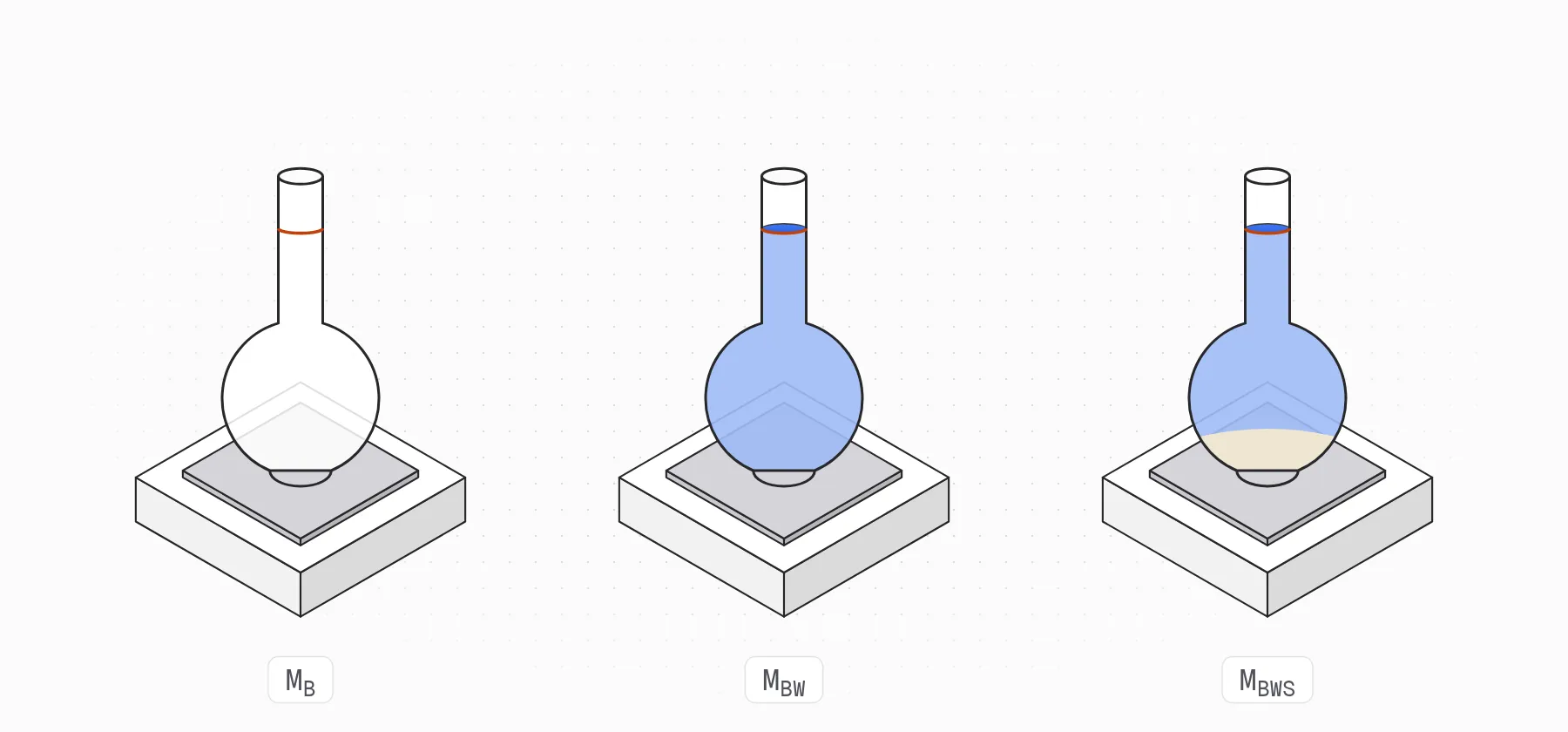
In the pycnometer test, the densities in the definition become three masses. Call the mass of the flask filled with water, and put a mass of dry soil into it. The soil pushes out a volume of water equal to the volume of the grains, , so the flask with water and soil weighs:
Solving for the mass of the water the grains displaced, , and dividing the mass of the grains by it gives the specific gravity formula of the pycnometer test:
Where:
is the specific gravity of the soil solids at the test temperature ,
is the mass of the oven-dry soil, in g,
is the mass of the flask filled with water to the calibration mark, at temperature , in g,
is the mass of the flask filled with water and soil to the same mark, at temperature , in g.
The denominator is the mass of the water that the grains displace. The same idea works for any solid: its specific gravity is its density divided by the density of water.
Specific gravity of water and the temperature correction
The specific gravity of water is 1 when it is compared with water at the same temperature. Its density does change with temperature, though: the calculator uses 0.99821 g/mL at 20 °C and 0.99705 g/mL at 25 °C. Two consequences follow for the test:
- and must both be at the same temperature . A flask that holds 250 mL of water at 20 °C holds about 0.3 g less water at 25 °C. With 30 g of soil displacing about 11 g of water, an error of 0.3 g in moves by about 0.07.
- The result at the test temperature is referred to water at 20 °C with the temperature coefficient , the specific gravity of water at relative to water at 20 °C:
At 25 °C, . ASTM D854 tabulates against temperature; Caltrans CT 209 publishes a similar table.
Equipment
- Pycnometer: a stoppered flask, a stoppered iodine flask or a volumetric flask of at least 250 mL. Flasks of 250 mL and 500 mL are the usual sizes.
- Balance readable to 0.01 g, with a capacity of at least 500 g for a 250 mL pycnometer or at least 1,000 g for a 500 mL one.
- Drying oven that holds 110 ± 5 °C.
- Thermometer readable to 0.1 °C, with a maximum error of 0.5 °C, that can be read at an immersion depth between 25 and 80 mm.
- Desiccator with silica gel or anhydrous calcium sulfate, to cool the dried soil without it taking up moisture.
- A way to remove entrapped air: a vacuum pump or water aspirator that brings the absolute pressure below 100 mm Hg (13.33 kPa), or a hot plate or Bunsen burner that can keep water boiling.
- Insulated container with a lid, such as a foam cooler, big enough for three to six pycnometers plus a beaker or bottle of de-aired water, an eyedropper and the thermometer.
- Funnel of smooth, non-corrosive material, with a stem that reaches past the calibration mark or the stopper seat, and a filling tube with side vents, to add water without stirring up the slurry.
- Blender with mixing blades, to disperse moist specimens (Method A).
- No. 4 (4.75 mm) sieve, and the 9.5 mm sieve if you follow the 2023 edition’s split.
- Distilled water, de-aired for calibration and for topping up.
- Evaporating dish or pan large enough for the whole slurry.
Calibrating the pycnometer
The calibration gives the volume of the flask up to its mark. With that volume you can work out at whatever temperature the test ends up at, without having to reach a set temperature.
-
Weigh the clean, dry pycnometer to 0.01 g. Repeat the weighing five times and record the average, . The standard deviation of the five weighings must be 0.02 g or less.
-
Fill the pycnometer with de-aired distilled water to a little above or below the calibration mark.
-
Put it in the covered insulated container together with the thermometer, the stopper (for a stoppered flask), and a beaker of de-aired water with an eyedropper. Leave it at least 3 hours to reach thermal equilibrium.
-
Without taking it out of the container, or after setting it on an insulating block, bring the water exactly to the mark with the eyedropper, or seat the stopper and remove the water it pushes out. Dry the rim and the outside of the flask.
-
Weigh the pycnometer with water to 0.01 g, , and measure the water temperature to 0.1 °C, .
-
Return the pycnometer to the container and repeat steps 3 to 5 until you have five determinations, each after at least 3 hours of equilibrium.
-
Calculate the volume of the pycnometer for each determination:
Where is the calibrated volume of the pycnometer, in mL; the mass of the pycnometer with water at the calibration temperature, in g; the average mass of the dry pycnometer, in g; and the density of water at , in g/mL.
-
Average the five volumes. Their standard deviation must be 0.05 mL or less; if it is larger, refine the technique and calibrate again.
With known, the mass of the pycnometer full of water at the test temperature is:
Caltrans CT 209 writes the same correction in terms of masses, . The older USACE manual EM 1110-2-1906 instead weighs the flask with water at several temperatures and draws a calibration curve from which is read at . Any of the three gives at the temperature of the test.
The calibration stays valid while the empty pycnometer keeps its mass. Before each test, weigh it on the same balance used for the calibration: if it differs from by more than 0.06 g, calibrate it again.
Pycnometer test procedure (ASTM D854)
Method A or Method B
ASTM D854 has two ways of preparing the specimen:
- Method A, with moist specimens, is the preferred method. It is required for organic soils, highly plastic fine-grained soils, tropical soils and soils containing halloysite, because oven-drying can alter some of these soils or make them hard to wet again.
- Method B, with oven-dried specimens, takes less time and suits clean sands.
In both methods the dry mass of the soil, , is measured at the end of the test by drying the recovered slurry.
Specimen mass
The dry mass of the specimen depends on the soil type and on the size of the pycnometer (ASTM D854-14):
| Soil type (USCS) | Dry mass, 250 mL pycnometer (g) | Dry mass, 500 mL pycnometer (g) |
|---|---|---|
| SP, SP-SM | 60 ± 10 | 100 ± 10 |
| SP-SC, SM, SC | 45 ± 10 | 75 ± 10 |
| Silt or clay | 35 ± 10 | 50 ± 10 |
Method A: preparing a moist specimen
-
Weigh the empty pycnometer and check that its mass is within 0.06 g of the calibrated .
-
Determine the water content of the soil (ASTM D2216) on a separate portion.
-
With that water content, work out the range of moist masses that will give a dry mass within the table’s range.
-
Take a specimen whose moist mass falls within that range. There’s no need to trim it to an exact mass.
-
Add about 100 mL of water and disperse the soil in the blender.
-
Pour the slurry into the pycnometer through the funnel, and rinse the soil left on the funnel and in the blender cup into the pycnometer.
Method B: preparing an oven-dried specimen
-
Weigh the empty pycnometer and check that its mass is within 0.06 g of the calibrated .
-
Dry the soil to constant mass in the oven at 110 ± 5 °C.
-
Spoon the dry solids into the pycnometer through the funnel, using a mass within the table’s range.
-
Add distilled water until it fills between a third and a half of the depth of the main body of the pycnometer.
-
Swirl the water until the soil forms a slurry.
Removing the entrapped air
Entrapped air is the main source of error in this test: a bubble left among the grains is counted as soil volume and lowers . ASTM D854 removes it in one of these ways:
- Boiling for at least 2 hours, agitating the pycnometer from time to time.
- Vacuum for at least 2 hours, below 100 mm Hg absolute, agitating the pycnometer continuously.
- Boiling and vacuum together for at least 1 hour counted from when boiling starts, rolling the pycnometer now and then.
Under vacuum, a warm water bath no hotter than 40 °C helps the air come out; keep the bath level slightly below the water level inside the pycnometer. Watch the slurry while it boils, because a violent boil can throw soil out of the flask.
Filling, equilibrium and weighing
-
Fill the pycnometer with de-aired water to a little above or below the calibration mark. Add the water through the filling tube or a small tube held against the neck, slowly, so that a layer of clear water forms over the slurry.
-
If you used heat, let the pycnometer cool to room temperature.
-
Put the pycnometer in the insulated container with the thermometer, a beaker of de-aired water and the eyedropper, and leave it overnight to reach thermal equilibrium.
-
Set the pycnometer on an insulating block, or work inside the container. Bring the water exactly to the calibration mark with the eyedropper, or seat the stopper and remove the water it pushes out.
-
Dry the rim and the outside of the pycnometer, and for a volumetric flask the inside of the neck above the mark. Handle the flask as little as possible, or wear gloves, so the heat of your hands doesn’t change its temperature.
-
Weigh the pycnometer with soil and water to 0.01 g. This is .
-
Measure the temperature of the slurry to 0.1 °C with the thermometer that sat in the container, at the immersion depth it is designed for. This is the test temperature, .
-
Record the mass of a clean evaporating dish, . Pour the slurry into it and rinse the pycnometer with distilled water until no soil is left inside. Use a plastic squeeze bottle or a rubber-tipped rod; metal tools can scratch the glass.
-
Dry the soil in the oven at 110 ± 5 °C to constant mass, let it cool in the desiccator, and weigh the dish with the dry soil to 0.01 g. This is .
ASTM D854 calls for a single specimen. If you test a second one as a check, it is a complete test of its own, with its own de-airing and night of equilibrium.
Calculations
-
Mass of the dry soil:
Where is the mass of the oven-dry soil, the mass of the dish with the dry soil, and the mass of the empty dish, all in g.
-
Mass of the pycnometer full of water at the test temperature, from the calibration:
The calculator takes weighed at the test temperature or, switched to the calibration, works it out from and .
-
Specific gravity at the test temperature:
-
Specific gravity at 20 °C:
-
If the sample had particles retained on the dividing sieve, combine the specific gravity of the fine fraction (D854), , with that of the coarse fraction (ASTM C127), . The combination is made on the volume of the solids, which is what USACE EM 1110-2-1906 calls for:
Where and are the fractions of the total dry mass that pass and are retained on the dividing sieve, as decimals (). The calculator combines the two when you switch on the coarse fraction.
With the calculator’s example: the dish weighs g and, with the dry soil, g, so g. At °C the pycnometer weighs g with water and g with water and soil. The soil displaced g of water, so . At 20 °C, and . Had the test run at 25 °C with the same masses, .
Report
- Identification of the sample and the fraction tested (the sieve it passes).
- Method used (A or B) and how the entrapped air was removed.
- Test temperature, .
- Specific gravity at 20 °C, . ASTM D854 sizes its balances, pycnometers and specimens so the result can be reported to four significant digits, for example 2.691.
- If the sample had a coarse fraction: its specific gravity by ASTM C127, the fractions and , and the combined value.
Typical values and common mistakes
Most soils have a specific gravity between 2.60 and 2.80. Values from about 2.2 up to 3.5 are possible, but a result outside 2.60 to 2.80 calls for a second look at the test before it is accepted. Without a test, an FHWA research report takes 2.65 for sands and gravels and 2.78 for silts and clays. Organic matter, much lighter than mineral grains, pulls down; heavy minerals such as iron oxides push it up.
The usual causes of a wrong result:
- Air left in the slurry, usually from cutting the de-airing short. It gives a that is too low.
- taken at a different temperature from . Use the calibration to bring to the test temperature.
- Soil lost while transferring it into the pycnometer, during boiling, or while washing it out into the dish.
- Water on the rim or the outside of the flask, or the water level off the mark, when weighing.
- A flask that has changed mass (chipped, or with residue) and was not calibrated again.
References
- ASTM International. ASTM D854-23, Standard Test Methods for Specific Gravity of Soil Solids by the Water Displacement Method. Scope and summary: store.astm.org/d0854-23.html.
- NICET (2020). Performance Examination checklist, ASTM D854-14 [AASHTO T 100]: nicet.org.
- California Department of Transportation (2011). California Test 209, Method of Test for Specific Gravity of Soils: dot.ca.gov.
- U.S. Army Corps of Engineers (1970, with changes to 1986). EM 1110-2-1906, Laboratory Soils Testing, Appendix IV: Specific Gravity.
- Hossain, M. S., Islam, M. A., Badhon, F. F., & Imtiaz, T. (2021). Properties and Behavior of Soil: Online Lab Manual, chapter 2, Specific Gravity Test. University of Texas at Arlington: uta.pressbooks.pub.
- Federal Highway Administration (2004). FHWA-HRT-04-094, Evaluation of LS-DYNA Soil Material Model 147, chapter 4: fhwa.dot.gov.
- Germaine, J. T., & Germaine, A. V. (2009). Geotechnical laboratory measurements for engineers.