

Sieve analysis of soil: ASTM D6913 test and gradation curve
How to run a sieve analysis of soil by ASTM D6913 (methods A and B), from washing over the No. 200 to the gradation curve, D10, D30, D60, Cu, and Cc.
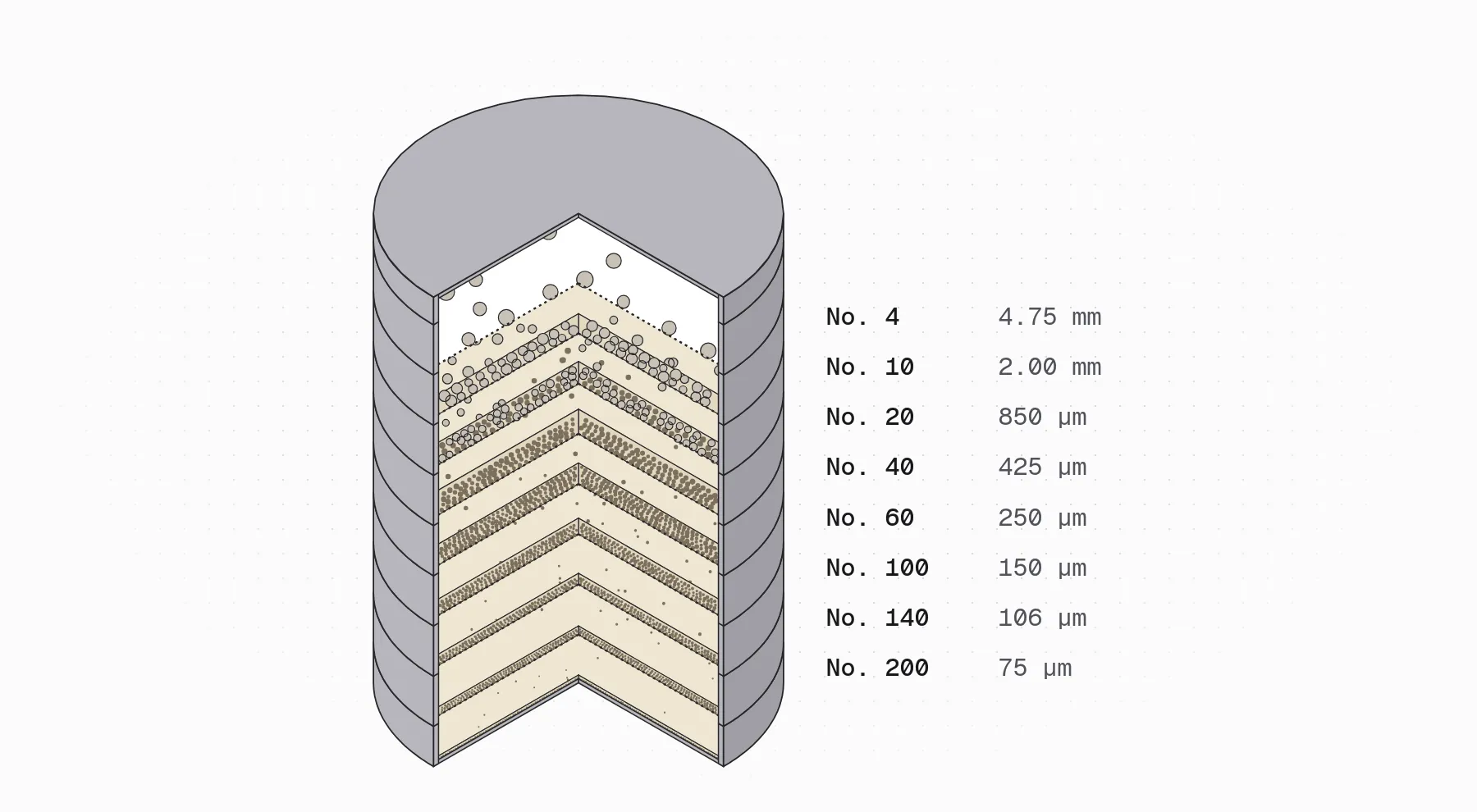
A sieve analysis measures the particle size distribution of a soil between the 3 in. (75 mm) and the No. 200 (75 µm) sieves. The soil is washed, dried and shaken through a stack of sieves with smaller and smaller openings, and the mass each sieve retains gives the percent passing at each size. Plotted against the logarithm of the opening, those percentages form the gradation curve, which gives D10, D30 and D60, the coefficients of uniformity and curvature, and the gravel, sand and fines fractions you need to classify the soil under ASTM D2487. The test is standardized in ASTM D6913, which has two methods (A and B) and two ways of sieving (single sieve set or composite).
Sieve analysis calculator
Calculator · ASTM D6913
The sieve stack
From the coarsest sieve to the finest. The empty sieve is the clean instrument with its base; the full one, the same after the test. What each retained is the difference.
| Sieve | Opening(mm) | Empty sieve(g) | Sieve with what it retained(g) |
|---|---|---|---|
| 2" | |||
| 3/2" | |||
| 1" | |||
| 3/4" | |||
| 1/2" | |||
| 3/8" | |||
| #4 | |||
| #8 | |||
| #10 | |||
| #16 | |||
| #30 | |||
| #50 | |||
| #100 | |||
| #200 | |||
| Pan |
- 0.7 % passes the #200, so D10 falls in the sieved part. If you need the fines' curve, go on with a sedimentation analysis (ASTM D7928).
- Cc = 0.05, outside the 1 to 3 of a good grading: the curve has a step, a jump from one size to another that makes the material hard to work with in practice.
With 14 sieves and 3273.1 g of dry sample, the curve runs from 50.8 mm to 0.074 mm; the maximum particle size is 50.8 mm, the finest sieve retaining less than 1 %, so it takes Method A, which reports the percent passing to 1 %. What was retained adds up to 3271.4 g against the 3273.1 g to start with: a difference of 1.7 g, 0.05 % of the sample. D10 = 0.298 mm, D30 = 0.548 mm and D60 = 20.53 mm, hence Cu = 68.8 and Cc = 0.05. Gravel is the 57.8 % retained above the #4, sand the 41.5 % between the #4 and the #200, and fines the 0.7 % passing the #200
The test's result
| Quantity | Value |
|---|---|
| Total mass retainedthe sum of what each sieve retained | 3271.4g |
| Mass balanceinitial mass − mass retained | 1.7g |
| Imbalanceover initial mass | 0.052% |
| Maximum particle sizethe finest sieve retaining less than 1 % | 50.8mm |
| Gravelcumulative retained on the #4 | 57.8% |
| Sandpassing the #4 − passing the #200 | 41.5% |
| Finespassing the #200 | 0.7% |
| D10the opening with 10 % passing | 0.298mm |
| D30the opening with 30 % passing | 0.548mm |
| D60the opening with 60 % passing | 20.53mm |
| CuD60 / D10 | 68.80 |
| CcD30² / (D10 · D60) | 0.049 |
Percent passing
| Quantity | Value |
|---|---|
| 2"50.8 mm | 100% |
| 3/2"38.1 mm | 97% |
| 1"25.4 mm | 75% |
| 3/4"19 mm | 55% |
| 1/2"12.7 mm | 47% |
| 3/8"9.51 mm | 43% |
| #44.76 mm | 42% |
| #82.38 mm | 42% |
| #102 mm | 41% |
| #161.19 mm | 37% |
| #300.595 mm | 33% |
| #500.297 mm | 10% |
| #1000.149 mm | 2% |
| #2000.074 mm | 1% |
This calculator is offered for information and technical support. It doesn't replace professional judgment or the reviews due, and its use is the user's responsibility.
The calculator also has a page of its own, to keep at hand: the sieve analysis calculator.
What is sieve analysis?
Sieving separates the soil grains by size with woven-wire sieves of square openings, sized to ASTM E11. Each grain either passes an opening or stays on it, so the mass retained on each sieve is the mass of grains between that sieve and the one above. Added up from the top of the stack, those masses give the percent of the soil finer than each opening.
The method covers sands and gravels. Below 75 µm (the No. 200 sieve) the grains are too small to sieve reliably, and silt and clay particles stick to each other and to the coarser grains. That’s why D6913 washes the fines out over the No. 200 sieve before dry sieving and counts them as the material passing it. When you need the distribution of that finer part, it’s measured by sedimentation with ASTM D7928 (see the hydrometer analysis). Particles larger than 3 in. fall outside D6913 as well; ASTM D5519 covers them.
D6913 isn’t meant for soils with fibrous peat, with extraneous matter such as oil, asphalt or wood fragments, or with cementing admixtures such as cement, fly ash or lime. Friable soils that break down while they’re sieved (some residual soils, weathered shales, weakly cemented soils) and clays that don’t disperse can be tested, but the method has to be adapted and the changes reported.
Particle size distribution and the gradation curve
The grain size distribution curve, or gradation curve, plots the percent passing on the vertical axis (arithmetic scale) against the particle size on the horizontal axis (logarithmic scale, in millimeters). The log scale gives the same width to every factor of ten in size, from 75 mm down to 0.075 mm.
Three points on the curve summarize the gradation:
- : the particle size at which 10% of the soil passes, also called the effective size.
- : the particle size at which 30% passes.
- : the particle size at which 60% passes.
Reading D10, D30 and D60 on the log scale
A sieve analysis gives one point per sieve, so each is interpolated between the two sieves whose percent passing brackets . Because the size axis is logarithmic, the interpolation is a straight line between those two points on the semi-log plot, which is linear in the logarithm of the opening:
Where:
- : Particle size at percent passing (10, 30 or 60), in mm.
- , : Openings of the two sieves that bracket , in mm.
- , : Percent passing those two sieves.
Interpolating linearly in millimeters gives a wrong value. A that falls below the finest sieve or above the coarsest one can’t be read from the sieve analysis: it isn’t extrapolated. If more than 10% passes the No. 200 sieve, for example, is finer than 0.075 mm and needs the hydrometer analysis.
Coefficient of uniformity and coefficient of curvature
D6913 uses the gradation curve to compute the coefficient of uniformity () and the coefficient of curvature ():
measures how wide the range of sizes is: the larger it is, the more sizes the soil has. measures the shape of the curve between and : values outside the range below point to a missing band of sizes (a gap-graded soil) or to sizes bunched together.
For classification, ASTM D2487 calls a gravel well graded (GW) when and , and a sand well graded (SW) when and . A coarse soil that misses either condition is poorly graded (GP or SP).
ASTM D6913: methods A and B, single and composite sieving
D6913 has two methods. They differ in how precisely the percent passing is recorded and, because of that, in how much soil they need:
- Method A records the percent passing each sieve to the nearest 1%. It’s the default when nobody specifies a method, the referee method in a dispute, and the only one allowed with composite sieving.
- Method B records the percent passing to the nearest 0.1%. It applies only to single sieve-set sieving of soils whose maximum particle size is 4.75 mm (No. 4) or smaller.
The sieving procedure depends on the maximum particle size:
- Single sieve-set sieving puts the whole specimen through one stack of sieves. It’s the usual choice when the maximum particle size is 4.75 mm (No. 4) or smaller.
- Composite sieving splits the specimen on a designated separating sieve. The coarser portion is sieved whole, and only a representative subspecimen of the finer portion is sieved; the two results are then combined. It applies when the maximum particle size is 19.0 mm (3/4 in.) or larger. Between 4.75 mm and 9.5 mm (3/8 in.) either procedure is allowed.
The maximum particle size is the smallest sieve in the standard set that would retain less than 1% of the sample. The specimen has to have at least the dry mass in D6913’s Table 2 for that size and method:
| Maximum particle size (mm) | Sieve | Minimum dry mass, Method A (nearest 1%) | Minimum dry mass, Method B (nearest 0.1%) |
|---|---|---|---|
| 76.2 | 3 in. | 70 kg | Not applicable |
| 50.8 | 2 in. | 25 kg | Not applicable |
| 38.1 | 1 1/2 in. | 10 kg | Not applicable |
| 25.4 | 1 in. | 3 kg | Not applicable |
| 19.0 | 3/4 in. | 1.3 kg | Not applicable |
| 9.5 | 3/8 in. | 165 g | Not applicable |
| 4.75 | No. 4 | 75 g | 200 g |
| 2.00 | No. 10 | 50 g | 100 g |
| 0.425 | No. 40 | 50 g | 75 g |
The masses climb fast with the particle size because a single large particle weighs a lot: with too small a specimen, one gravel particle more or less moves the percent passing by more than the method’s precision.
Equipment
-
Sieves of 200 mm (8 in.) diameter or larger, to ASTM E11, with a pan and a lid. D6913’s standard sieve set has fourteen sieves; other sieves can be added when a specification asks for them.
Sieve Opening 3 in. 75 mm 2 in. 50 mm 1 1/2 in. 37.5 mm 1 in. 25.0 mm 3/4 in. 19.0 mm 3/8 in. 9.5 mm No. 4 4.75 mm No. 10 2.00 mm No. 20 850 µm No. 40 425 µm No. 60 250 µm No. 100 150 µm No. 140 106 µm No. 200 75 µm -
A No. 200 (75 µm) washing sieve for washing out the fines, which can be protected with a coarser sieve on top.
-
The designated separating sieve, for composite sieving.
-
A mechanical sieve shaker, verified as D6913 specifies. The verification also sets its standard shaking period.
-
Balances with the capacity and readability D6913 requires for the specimen’s mass and the method.
-
A drying oven at 110 ± 5 °C, the standard drying temperature of ASTM D2216.
-
A washing sink with a spray nozzle, and containers for the specimen and for the cumulative mass retained.
-
Sieve brushes: coarse and fine wire brushes for sieves of 850 µm and larger, fine nonmetallic-bristle brushes for sieves of 150 µm and smaller, and coarse nonmetallic-bristle brushes for the sieves in between.
-
Sodium hexametaphosphate as the dispersant, added dry or as a solution.
-
Optionally, a splitter or riffle box, quartering tools, a mortar with a rubber-covered pestle to break up lumps without crushing grains, a low-temperature drying oven, an ultrasonic water bath and a dispersion shaker.
Sieve analysis procedure (ASTM D6913)
D6913 processes the sample in one of three states: moist, air dried or oven dried. The choice depends on the soil type, its maximum particle size, its plasticity and what other tests need the sample. Moist processing suits soils with fines, because drying can cement clay lumps that then don’t break down; clean sands and gravels can be dried first. The steps below follow the moist procedure with single sieve-set sieving, and then describe what changes with composite sieving. The calculator handles both.
Preparing the specimen
- Estimate the maximum particle size: the smallest sieve in the standard set on which less than 1% of the sample would be retained.
- Choose the method (A or B) and the sieving procedure (single set or composite), and look up the minimum dry mass in Table 2.
- Mix the sample until it’s uniform, breaking up obvious lumps by hand or with the rubber-covered pestle without crushing grains.
- With a splitter or by quartering, take a specimen of at least the minimum dry mass, plus a separate portion for the water content.
- Determine the water content of that portion by ASTM D2216.
- Weigh the moist specimen in a container of known mass: that’s .
Washing over the No. 200 sieve
-
Cover the specimen with water and let it soak, with sodium hexametaphosphate if the fines are clayey. An ultrasonic bath or a dispersion shaker helps with soils that are hard to disperse.
-
Stir with a hard rubber paddle, breaking up any clumps.
-
Set up the washing station: the No. 200 sieve, with a coarser sieve on top to protect it (Germaine and Germaine use the No. 40).
-
Wash the specimen through the sieves in small portions, so the No. 200 doesn’t clog or overflow.
-
Keep washing until the water passing the No. 200 runs clear.
-
Move everything retained on both sieves to a container of known mass, without losing any grains.
-
Oven-dry the washed material at 110 ± 5 °C to constant mass and weigh it: that’s the washed dry mass, .
-
Optionally, collect all the wash water in a container of known mass, dry it in the oven and weigh the fines, as a check on the dry mass (calculation 7). That mass includes the dispersant you added.
Dry sieving
- Select and clean a set of sieves suited to the shaker and to the soil’s gradation. The largest sieve must let all of the material through, and the set must go down to the 75 µm sieve without leaving out any standard sieve in between.
- Inspect each empty sieve for stuck grains or torn mesh, and record its size and mass.
- Assemble the stack with the pan at the bottom, pour the dry washed soil onto the top sieve and put on the lid.
- Shake the stack for the shaker’s standard shaking period, the one set when the shaker was verified. D6913 doesn’t fix a single time; 15 to 20 minutes is typical for soils.
- Take the stack apart and check the sieving by hand: hold each sieve over a sheet of white paper and tap it. If a significant amount of soil falls onto the paper, the sieving wasn’t finished; repeat the shaking.
- Weigh each sieve with the soil it retained, and the pan. D6913 does it cumulatively instead: it empties each sieve, from the coarsest down, into one container and weighs the cumulative mass retained after each sieve. Both give the same result.
- Check that no sieve is overloaded (see below). If one is, sieve the soil again in two or more portions, or use sieves of a larger diameter.
- Empty and brush the sieves.
Sieve overloading
A sieve with too much soil on it doesn’t let the finer grains reach the mesh, so it retains grains that should have passed. D6913 sets the most each sieve may hold at the end of sieving, based on the number of grain layers the sieve can carry: one layer for the coarsest sieves and up to six for the finest. For 200 mm (8 in.) sieves the limits are:
| Sieve | Maximum retained |
|---|---|
| 3 in. | 2700 g |
| 2 in. | 2000 g |
| 1 1/2 in. | 1500 g |
| 1 in. | 1100 g |
| 3/4 in. | 900 g |
| 3/8 in. | 550 g |
| No. 4 | 325 g |
| No. 10 | 180 g |
| No. 20 | 112 g |
| No. 40 | 75 g |
| No. 60 | 60 g |
| No. 100 | 40 g |
| No. 140 | 30 g |
| No. 200 | 20 g |
Larger sieves (305 mm or 12 in., and rectangular ones) have higher limits.
Composite sieving
For soils with gravel of 19.0 mm (3/4 in.) or larger, sieving the whole specimen on fine sieves would overload them and take far too long. Composite sieving splits the work in two (Method A only):
- Separate the whole specimen on the designated separating sieve.
- Dry and weigh the coarser portion (the part retained on the separating sieve), wash it over the No. 200 if fines cling to it, dry it again and sieve it on the coarse sieves. The mass it loses in washing plus the mass in its pan, as a percentage of the specimen’s dry mass, must stay within D6913’s acceptable loss of 0.5%.
- Weigh the finer portion (the part passing the separating sieve) moist and determine its water content, to get its dry mass.
- From the finer portion, take a representative subspecimen by splitting or quartering, with at least the minimum mass for its own maximum particle size. Wash, dry and sieve it on the fine sieves as in a single sieve set.
- Combine the two results (calculations 5 and 6). When the finer portion is still too large or too coarse for one subspecimen, D6913 allows a second separation on a smaller sieve, with a second subspecimen.
Calculations
- Take the size specified for each sieve as the particle size.
- Get the dry mass () of the specimen from its moist mass and the water content of the companion portion:
Where:
- : Moist mass of the specimen.
- : Water content of the companion portion, in %.
If you processed the specimen oven dried, is weighed directly before washing.
- Determine the percent passing each sieve, starting with the largest sieve and working down to the smallest.
Where:
- : Percent passing sieve .
- : Dry mass retained on sieve .
- : The sieve’s position in the stack, counting from the largest opening.
The percentages are always over , the dry mass before washing. Over the sum retained, the fines washed out would vanish from the result. Round to 1% for Method A and to 0.1% for Method B.
-
The percent passing the No. 200 sieve is for that sieve. It includes the fines washed out and what fell into the pan during dry sieving, which is why it’s the fines content used in classification.
-
In composite sieving, the specimen’s total dry mass is the coarser portion’s dry mass plus the finer portion’s dry mass, worked out from its moist mass and water content:
Where:
- : Dry mass of the coarser portion.
- : Moist mass of the finer portion.
- : Water content of the finer portion, in %.
The percent passing the coarse sieves, down to the separating sieve, comes from calculation 3 with this .
- In composite sieving, the subspecimen gives the percent passing within the finer portion, and that is scaled by the percent of the whole specimen that passed the separating sieve:
Where:
- : Percent of the specimen passing the separating sieve.
- : Dry mass of the subspecimen.
- : Dry mass of the subspecimen retained on fine sieve .
- Check the mass. The sum of the masses on the sieves and the pan should match the washed dry mass ; a large difference means grains lost from the sieves or a weighing error. If you dried the wash water (step 14), you also get an alternate dry mass : the washed dry mass plus the dry fines, minus the dispersant you added. The percent error in the dry mass is:
In the calculator, the mass you enter is . If you also enter , the pan row holds only what fell into the pan while sieving, the fines washed out are , and the sum of retained masses checks against . Without , the pan row carries everything finer than the No. 200 and the sum checks against . Either way, the calculator warns when the difference is over 1% of .
-
Interpolate , and on the log scale, each between the two sieves that bracket it, with the interpolation equation from the gradation curve section.
-
Compute and with their equations when , and are all on the curve.
-
Split the soil into gravel, sand and fines. Gravel is the percent retained on the No. 4 sieve (), sand the percent between the No. 4 and the No. 200 (), and fines the percent passing the No. 200 ().
Sieve analysis table
This worksheet organizes the single sieve-set calculations, sieve by sieve:
| Sieve No. | Opening (mm) | Mass of empty sieve (g) | Mass of sieve + soil retained (g) | Mass of soil retained (g) | Percent retained (%) | Cumulative percent retained (%) | Percent passing (%) |
|---|---|---|---|---|---|---|---|
| A | B | C | D | E | F | ||
| 4 | 4.75 | ||||||
| 10 | 2 | ||||||
| 20 | 0.85 | ||||||
| 40 | 0.425 | ||||||
| 60 | 0.25 | ||||||
| 100 | 0.15 | ||||||
| 140 | 0.106 | ||||||
| 200 | 0.075 | ||||||
| Pan | |||||||
| Total mass retained () |
Column F is the same of calculation 3, and starts from .
Report
For each specimen, report:
- The method (A or B), the sieving procedure (single sieve set, or composite with its separating sieve or sieves) and how the sample was processed (moist, air dried or oven dried).
- Whether the specimen was washed, and the dispersant and soaking time if any.
- The percent passing each sieve, rounded for the method, and the gradation curve: percent passing on the y axis and particle size in millimeters on a logarithmic x axis. State that it was obtained by sieve analysis, and by hydrometer analysis for any part below 75 µm.
- Maximum particle size, in mm.
- , and , in mm, or which of them the curve doesn’t reach.
- Coefficient of uniformity () and coefficient of curvature ().
- Percent of gravel, sand and fines; the fines are the percent passing the 75 µm (No. 200) sieve.
- The mass check, and anything unusual: friable grains, lumps that didn’t break down, organic matter.
Common mistakes
- Sieving dry without washing first. The fines stick to the sand and gravel and stay on the coarse sieves, so the fines content comes out too low and the soil can be misclassified.
- Overloading the sieves. The soil retained on an overloaded sieve includes grains that should have passed it, which shifts the curve to the coarse side.
- Leaving out sieves. A stack that skips standard sieves leaves wide gaps where , or has to be interpolated, and misses a jump in the gradation.
- Taking the percentages over the sum retained. That hides the washed fines and spreads the loss over every sieve. The percentages go over .
- Interpolating in millimeters, or extrapolating. is interpolated on the log scale, and a beyond the last sieve calls for another sieve or for the hydrometer analysis.
- Crushing grains. Breaking up lumps with a hard pestle fractures particles and makes the soil look finer than it is.
References
- ASTM D6913/D6913M-17 (2025). Standard Test Methods for Particle-Size Distribution (Gradation) of Soils Using Sieve Analysis. ASTM International. Scope and significance: store.astm.org/d6913_d6913m-17r25.html
- ASTM D2216. Standard Test Methods for Laboratory Determination of Water (Moisture) Content of Soil and Rock by Mass. ASTM International.
- ASTM D2487. Standard Practice for Classification of Soils for Engineering Purposes (Unified Soil Classification System). ASTM International.
- ASTM D7928. Standard Test Method for Particle-Size Distribution (Gradation) of Fine-Grained Soils Using the Sedimentation (Hydrometer) Analysis. ASTM International.
- Germaine, J. T., & Germaine, A. V. (2009). Geotechnical laboratory measurements for engineers. Wiley.
- Hossain, M. S., Islam, M. A., Badhon, F. F., & Imtiaz, T. (2021). Properties and Behavior of Soil: Online Lab Manual, chapter 3, Sieve Analysis. Mavs Open Press, University of Texas at Arlington. uta.pressbooks.pub/soilmechanics/chapter/sieve-analysis
- University of Alabama. CE340 Laboratory Manual, Lab 2: Sieve Analysis. adhc.lib.ua.edu/ce340/?p=82
- GeoSystem Software. Grain Size Analysis Data Sheet, ASTM D6913. geosystemsoftware.com
- Humboldt Mfg. D422 Particle Size Analysis Replaced by D6913, D7928 Standards. humboldtmfg.com