

Phase relationships of soil: formulas and lab test
Phase relationships of soil: moisture content (ASTM D2216), density, void ratio, porosity, degree of saturation and unit weight, with formulas and lab steps.
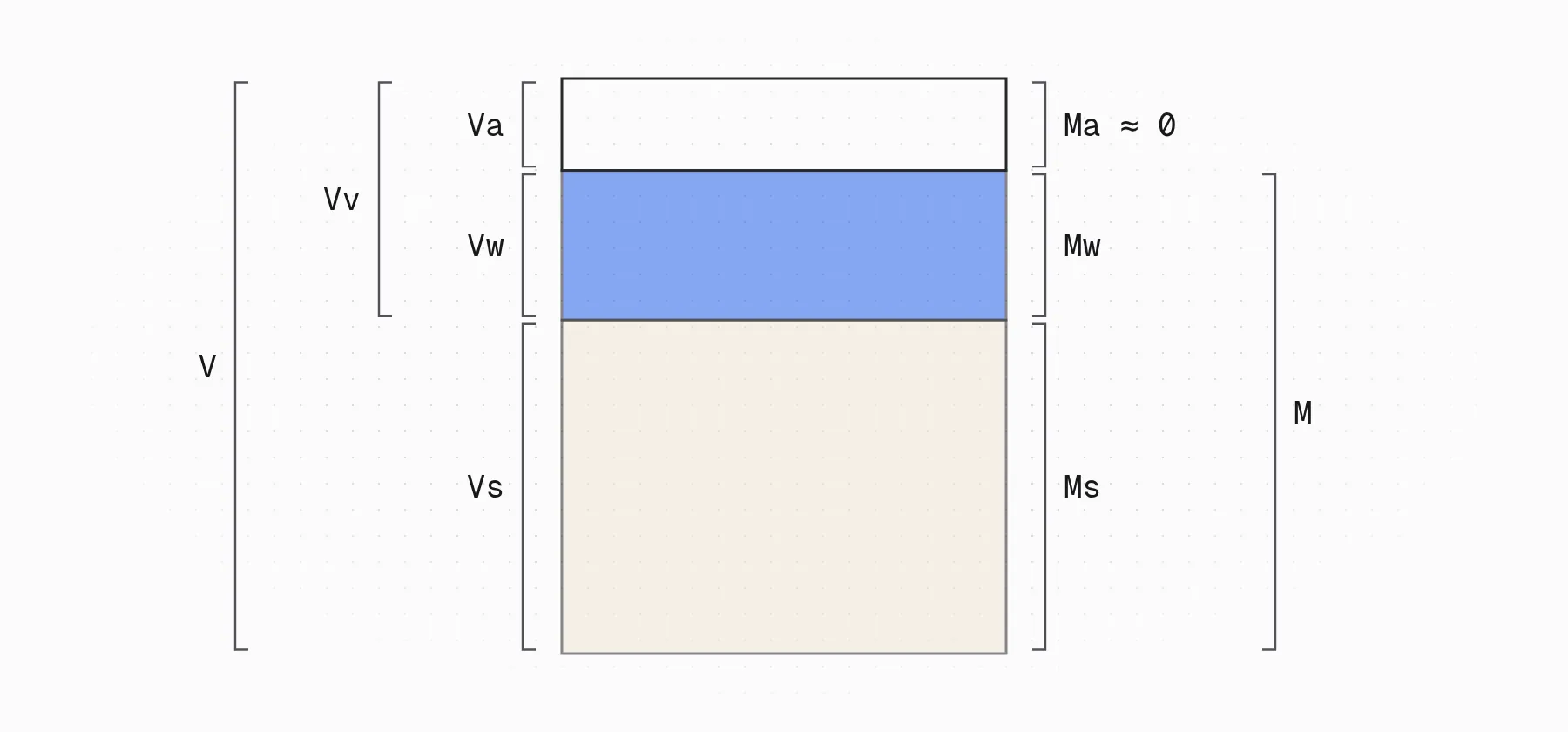
The phase relationships of soil describe how a sample divides into solid grains, water and air, by mass and by volume. In the lab you need three measurements: the specimen’s volume, its wet mass, and its dry mass after oven drying under ASTM D2216. Add the specific gravity of the solids from ASTM D854 and you get the moisture content, the density and unit weight, the void ratio, the porosity and the degree of saturation. Compaction control, settlement, permeability and strength calculations all start from these numbers.
Phase relationships calculator
Calculator · ASTM D2216 · D7263
- Solids64.0 %
- Water25.3 %
- Air10.8 %
Total volume 200.1 cm³Voids 72.1 cm³
S = 70.1 % · e = 0.563 · n = 36.0 %
A 4.95 × 10.4 cm cylinder: total volume 200.14 cm³. Wet mass 377.2 g, dry 326.7 g and water 50.5 g (water content 15.5 %). Wet density 1.885 g/cm³ and dry 1.632 g/cm³, which with g = 9.81 m/s² are unit weights of 18.5 and 16.0 kN/m³. With Gs = 2.554 and water at 0.99886 g/cm³, its density at the test's temperature, the grains take 128.06 cm³, so the voids take 72.08 cm³. Water fills 70.1 % of the voids: 29.9 % is left to take before it's saturated
The test's quantities
| Quantity | Value |
|---|---|
| Total volume · Vtπ D² H / 4 | 200.14cm³ |
| Wet mass · MtMtc − Mc | 377.2g |
| Dry mass · MsMdc − Mc | 326.7g |
| Water mass · MwMtc − Mdc | 50.5g |
| Moisture content · wMw / Ms × 100 | 15.5% |
| Wet density · ρMt / Vt | 1.885g/cm³ |
| Dry density · ρdMs / Vt | 1.632g/cm³ |
| Solids volume · VsMs / (Gs ρw) | 128.06cm³ |
| Voids volume · VvVt − Vs | 72.08cm³ |
| Void ratio · eVv / Vs | 0.563 |
| Porosity · nVv / Vt | 36.0% |
| Water volume · VwMw / ρw | 50.56cm³ |
| Degree of saturation · SVw / Vv × 100 | 70.1% |
| Wet unit weight · γ9.81 ρ | 18.5kN/m³ |
| Dry unit weight · γd9.81 ρd | 16.0kN/m³ |
| Check · S e = w Gsboth as decimals | 0.395 = 0.395 |
This calculator is offered for information and technical support. It doesn't replace professional judgment or the reviews due, and its use is the user's responsibility.
The calculator also has a page of its own, to keep at hand: the phase relations calculator.
Phase relationships of soil
A soil is a skeleton of solid particles with voids between them, and the voids hold water, air or both. The phase diagram draws the three phases stacked one on top of the other, with volumes on one side and masses on the other:
where:
- = total volume of the specimen
- = volume of the solids
- = volume of the voids
- = volume of the water
- = volume of the air
- = total (wet) mass of the specimen
- = mass of the dry solids
- = mass of the water
The mass of the air is taken as zero. Every quantity in the sections below is a ratio between two of these boxes, so it doesn’t depend on the size of the specimen.
Moisture content of soil
The moisture content, or water content, , is the mass of water divided by the mass of dry solids, expressed as a percentage:
It is measured on the dry mass, so it can go over 100 % in very soft clays and organic soils. ASTM D2216 defines the dry state as the one reached in an oven at 110 ± 5 °C: the mass the specimen loses there counts as water.
Density and unit weight of soil
The wet (total, or bulk) density is the mass of the whole specimen over its volume, and the dry density is the mass of the solids over the same volume:
In this formula and the ones that follow, and go in as decimals (15.5 % is 0.155).
Unit weight is weight per unit volume: density times the acceleration of gravity, = 9.81 m/s².
where is the wet (moist) unit weight, the dry unit weight, the density of water and the unit weight of water. With the density in g/cm³ (the same number as Mg/m³), the unit weight in kN/m³ is 9.81 times the density.
Two more unit weights come up in design. The saturated unit weight, , is the unit weight of the soil when water fills every void. The submerged (buoyant) unit weight, , is what a soil below the water table weighs once the buoyancy of the water is taken off:
Void ratio
The void ratio, , is the volume of voids divided by the volume of solids:
The volume of the solids comes from their dry mass and the specific gravity of the solids, , measured with ASTM D854 (see the specific gravity lesson):
From the dry density, the void ratio is:
Because it’s referred to the solids, whose volume doesn’t change, the void ratio is the quantity used to follow how a soil compresses or swells, as in the consolidation test.
Porosity of soil
The porosity, , is the fraction of the total volume taken by voids. It is often given as a percentage:
Porosity and void ratio describe the same thing with a different denominator, so each one gives the other:
Porosity can’t reach 1 (100 %), while the void ratio has no upper limit.
Degree of saturation
The degree of saturation, , is the share of the voids filled with water, as a percentage:
It goes from 0 % in a dry soil to 100 % in a saturated one. Below the water table most soils are saturated, and a partly saturated soil behaves differently in compaction, consolidation and undrained strength.
Phase relationship formulas
Combining the definitions gives the relationships used most in practice. The best known ties four of them together:
With it, the unit weights come from , and (or ):
The same formulas hold for densities if you swap every for a . They are also a good check on a lab result: if and don’t match, a mass, the volume or is wrong.
Typical void ratio and porosity values
Void ratios of some soils in their natural state, as given by Das and Sivakugan. The porosity column is calculated from them with .
| Soil | Void ratio, | Porosity, |
|---|---|---|
| Uniform sand, loose | 0.8 | 0.44 |
| Uniform sand, dense | 0.45 | 0.31 |
| Angular-grained silty sand, loose | 0.65 | 0.39 |
| Angular-grained silty sand, dense | 0.4 | 0.29 |
| Stiff clay | 0.6 | 0.38 |
| Soft clay | 0.9 to 1.4 | 0.47 to 0.58 |
| Loess | 0.9 | 0.47 |
| Soft organic clay | 2.5 to 3.2 | 0.71 to 0.76 |
| Glacial till | 0.3 | 0.23 |
Equipment
- Drying oven, preferably forced draft, that holds 110 ± 5 °C throughout.
- Balance readable to 0.01 g for specimens up to 200 g, and to 0.1 g for larger ones (ASTM D2216).
- Water content containers of a material that doesn’t corrode or change mass, each with its own number and a matching lid.
- Desiccator, to keep dried specimens from taking up moisture from the air.
- Calipers, to measure the dimensions of cylinders and blocks.
- Miter box (trimming guide), wire saw, knife and steel straightedge, to trim cohesive specimens.
- Wax paper or plastic sheets, and small glass or plastic plates, to handle soft specimens without touching them.
- For the wax method: microcrystalline wax, a pot to melt it with a thermostat, a brush, a wire basket that hangs from the balance, a container of water large enough to submerge it, and a thermometer readable to 0.1 °C.
- For coarse-grained soils: a mold of known volume, a spoon and a thin rod.
- Gloves or tongs, to handle hot containers.
Procedure (ASTM D2216 and D7263)
The test has two parts: measuring the volume of a specimen and drying it to get its masses. ASTM D7263 covers the density of soil specimens that keep their shape, with two methods: Method A finds the volume by water displacement with the specimen coated in wax, and Method B measures the dimensions directly. ASTM D2216 covers the moisture content. You also need , from ASTM D854.
Specimen volume
Pick the way that fits the soil. Whichever you use, the whole specimen whose volume you measure is the one that goes into the oven, so the masses and the volume belong to the same soil.
Cylinder or block measured with calipers (ASTM D7263, Method B)
D7263 asks for a specimen at least about 33 mm (1.3 in) in its smallest dimension, with the largest particle smaller than one tenth of that dimension.
Cylinder from a tube sample:
- Cut a length of the tube sample and trim both ends flat and perpendicular to the axis with the wire saw.
- Measure the height in three places and the diameter in nine places spread over the height, with calipers. Average them to get and .
Block trimmed from an intact sample:
Soft and medium-soft specimens are easy to disturb by hand. Cover them with wax paper and move them on small glass or plastic plates; this also keeps the soil from sticking to hard surfaces.
- Cut a first flat face with the miter box and the wire saw. Cover it with wax paper and set it face down on a plate.
- Trim a second face against the guide. Cover it with wax paper.
- Turn the specimen 90° on the plate, line it up with the guide and cut the third face. Move the wax paper to the new face.
- Repeat the previous step twice more, until the block has four square sides.
- Turn the block over onto a covered face and cut the last face.
- Measure each of the three dimensions at four points (the middle of each edge) and average them to get , and .
The measurements should be precise enough that the error in the volume stays under 1 % (USACE EM 1110-2-1906). For a cylinder, that error is about:
where and are the uncertainties of the diameter and height measurements.
Irregular piece coated in wax (ASTM D7263, Method A)
Use it when the soil can’t be trimmed to a regular shape, for example because it has gravel or shells. Wax doesn’t work on soils it can soak into.
- Trim a piece of fairly regular shape, without re-entrant corners. Patch any hole left by a particle that came out with soil from the trimmings.
- Weigh the specimen ().
- Coat it with a thin layer of melted wax, with a brush or by dipping it, and give it a second coat once the first one has hardened. The wax should be warm enough to flow but not so hot that it soaks into the soil or boils the water in it and leaves bubbles under the coat. Paraffin alone cracks as it cools, so microcrystalline wax is better.
- Weigh the coated specimen in air ().
- Hang the wire basket from the balance, submerged in the water, and zero the balance. Put the specimen in the basket, fully under water and with the basket clear of the sides and bottom, and record the reading (). Measure the water temperature.
- Peel off the wax and use the specimen for the moisture content, in the next section.
You also need the density of the wax, . It is around 0.9 g/cm³, but measure it for each batch.
Coarse-grained soil in a mold
A clean sand or gravel doesn’t keep its shape, so D7263 doesn’t cover it. In the lab it is placed in a mold whose volume you already know, the way the Proctor test does (see the Proctor lesson): you get the volume from the mold’s inside dimensions, or from the mass of water that fills it and that water’s density at its temperature.
- Fill about a third of the mold with moist soil, using a spoon.
- Rod the layer with the thin rod, the same number of strokes in every layer, so that specimens prepared alike are comparable.
- Repeat until the mold is full.
- Strike off the top level with the straightedge.
The volume of the specimen is the volume of the mold. Move all of the soil to the container in the next section without losing any.
Moisture content by oven drying (ASTM D2216)
- Weigh the clean, dry container with its lid () and write down its number.
- Put the specimen in the container, close the lid right away and weigh it (). A specimen loses water quickly, even in a covered container, so don’t wait.
- Take the lid off and put the container in the oven at 110 ± 5 °C. Don’t put wet specimens in an oven that holds dry ones, because the dry soil would take up moisture.
- Dry the specimen to constant mass, until weighing it again after more time in the oven no longer changes its mass. The time depends on the soil, the size of the specimen and the oven: USACE EM 1110-2-1906 gives at least 4 hours for clean sands and gravels and 16 hours for most other soils, and lab manuals usually dry overnight (16 to 24 hours). When in doubt, weigh at intervals.
- Take the container out, put the lid back on and let it cool until you can hold it with bare hands. If you can’t weigh it right away, keep it in the desiccator.
- Weigh the container with the dry specimen ().
Some soils call for a lower temperature. Gypsum loses its water of hydration at 110 °C and some organic matter decomposes, so these soils are dried at 60 °C or in a desiccator at room temperature. Report the temperature you used, because the result can differ from the one at 110 °C.
When only part of a sample is used for the moisture content, D2216 sets a minimum mass of moist soil according to the largest particle (the sieve that 100 % passes):
| Largest particle (100 % passing) | Method A (to 1 %) | Method B (to 0.1 %) |
|---|---|---|
| 2.00 mm (No. 10) | not listed | 20 g |
| 4.75 mm (No. 4) | 20 g | 100 g |
| 9.5 mm (3/8 in) | 50 g | 500 g |
| 19.0 mm (3/4 in) | 250 g | 2.5 kg |
| 37.5 mm (1.5 in) | 1 kg | 10 kg |
| 75.0 mm (3 in) | 5 kg | 50 kg |
D2216 has two methods that differ in how the result is recorded: Method A to the nearest 1 % and Method B to the nearest 0.1 %. Method A applies when nobody specifies one. For phase relationships, record the moisture content to 0.1 %, because it feeds the rest of the calculations; for the same reason, D2216 asks that a specimen of up to 200 g be weighed on a balance accurate to 0.01 g.
Calculations
- Calculate the total volume of the specimen. For a cylinder:
For a block:
With the wax method:
For coarse-grained soil, is the volume of the mold.
Where:
, = average diameter and height of the cylinder (cm)
, , = average dimensions of the block (cm)
= mass of the wax-coated specimen in air (g)
= balance reading with the coated specimen submerged (g)
= density of water at the test temperature (g/cm³)
= density of the wax (g/cm³)
With lengths in cm, the volume comes out in cm³.
- Get the wet mass of the specimen:
Where:
= mass of the container with the wet specimen (g)
= mass of the empty container (g)
- Get the dry mass of the specimen:
Where:
= mass of the container with the dry specimen (g)
If only part of the specimen was dried, as can happen with the wax method, take from that part and calculate the dry mass of the whole specimen as .
- Get the mass of water:
- Calculate the moisture content, in percent:
- Calculate the wet density:
- Calculate the dry density, from the dry mass or from the wet density and the moisture content:
- Calculate the volume of the solids:
Where:
= specific gravity of the solids (ASTM D854)
- Calculate the volume of the voids:
- Calculate the void ratio:
- Calculate the porosity:
- Calculate the volume of water:
- Calculate the degree of saturation, in percent:
- Calculate the wet and dry unit weights, in kN/m³, with the densities in g/cm³:
- Check the result: must equal (both as decimals), and can’t go over 100 %. If it does, check the dry mass, the volume and .
Worked example
This is the example the calculator opens with: a cylinder 4.95 cm across and 10.4 cm tall, with = 278.3 g, = 655.5 g, = 605.0 g, = 2.554 and = 0.99886 g/cm³.
| Quantity | Calculation | Result |
|---|---|---|
| Total volume, | 200.14 cm³ | |
| Wet mass, | 377.2 g | |
| Dry mass, | 326.7 g | |
| Mass of water, | 50.5 g | |
| Moisture content, | 15.5 % | |
| Wet density, | 1.885 g/cm³ | |
| Dry density, | 1.632 g/cm³ | |
| Volume of solids, | 128.06 cm³ | |
| Volume of voids, | 72.08 cm³ | |
| Void ratio, | 0.563 | |
| Porosity, | 36.0 % | |
| Volume of water, | 50.56 cm³ | |
| Degree of saturation, | 70.1 % | |
| Wet unit weight, | 18.5 kN/m³ | |
| Dry unit weight, | 16.0 kN/m³ |
The check closes: and .
Report
For each specimen, report:
- The sample and specimen identification, and a description of the soil.
- How the volume was measured (D7263 Method A or B, or the mold) and the dimensions or masses used.
- The moisture content, to 0.1 % (D2216 Method B) or to 1 % (Method A), with the drying temperature if it wasn’t 110 °C and any material left out of the specimen.
- The wet and dry densities, and the wet and dry unit weights.
- The specific gravity used and where it came from.
- The void ratio, the porosity and the degree of saturation.
Common mistakes
- A specimen that doesn’t represent the sample, such as one taken from a single layer of a stratified soil.
- Water lost before weighing the wet specimen, or gained before weighing the dry one.
- An oven that doesn’t hold 110 ± 5 °C, or a specimen taken out before it reaches constant mass.
- Weighing the container while it is still hot: the heat throws off the balance.
- Using the wrong container mass. Check container masses from time to time.
- Imprecise caliper readings, voids left when trimming, or soil lost while handling the specimen. With wax, voids the wax didn’t fill or air bubbles under the coat.
- A low or estimated : a saturation over 100 % usually points to it, or to the dry mass.
References
- ASTM D2216-19, Standard Test Methods for Laboratory Determination of Water (Moisture) Content of Soil and Rock by Mass, ASTM International. Scope: store.astm.org/d2216-19.html
- ASTM D7263-21, Standard Test Methods for Laboratory Determination of Density and Unit Weight of Soil Specimens, ASTM International. Scope: store.astm.org/d7263-21.html
- ASTM D854, Standard Test Methods for Specific Gravity of Soil Solids by the Water Displacement Method, ASTM International.
- U.S. Army Corps of Engineers (1970, with changes of 1980 and 1986). EM 1110-2-1906, Laboratory Soils Testing, Appendix I (Water content, general) and Appendix II (Unit weights, void ratio, porosity, and degree of saturation).
- NICET (2020). Performance examination checklist, ASTM D2216-19.
- Hossain, M. S., Islam, M. A., Badhon, F. F., & Imtiaz, T. (2021). Properties and Behavior of Soil: Online Lab Manual, chapter 1, “Determination of Moisture Content”. University of Texas at Arlington. uta.pressbooks.pub/soilmechanics
- Geocomp. Laboratory determination of density (unit weight) of soil specimens, ASTM D7263.
- Das, B. M., & Sivakugan, N. (2017). Principles of Foundation Engineering, SI edition, 9th ed. Cengage Learning.
- Germaine, J. T., & Germaine, A. V. (2009). Geotechnical Laboratory Measurements for Engineers. John Wiley & Sons.